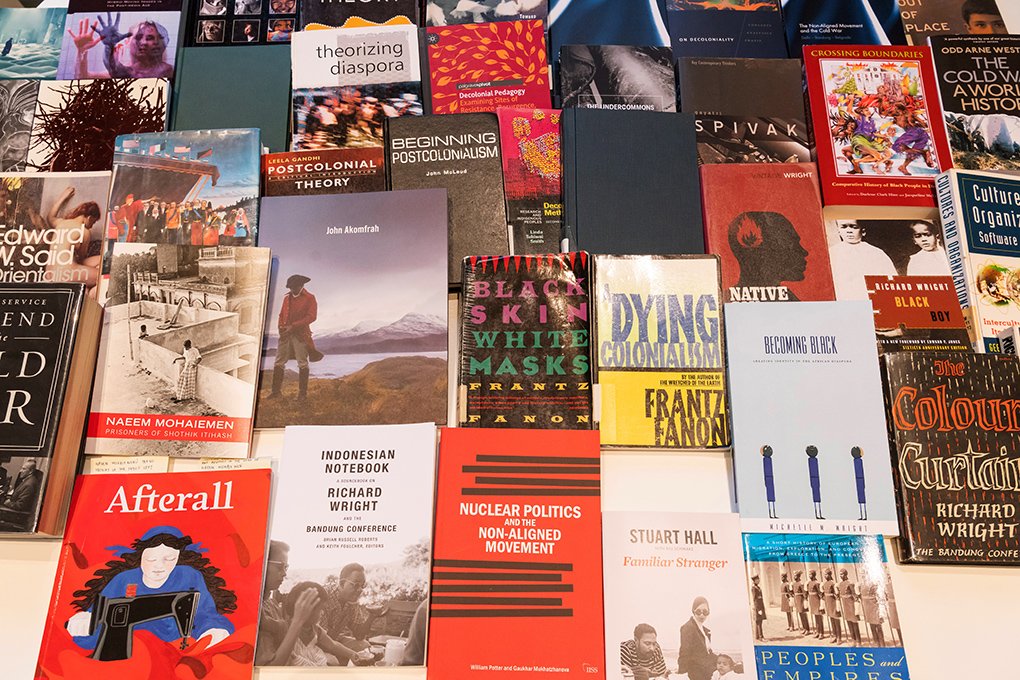
Non-Aligned Reading Corner

Non-Aligned, April 4 – September 27, 2020, Courtesy NTU CCA Singapore.

Reading Group
 

In light of COVID-19, the physical Reading Corner was removed, and resources were provided for the public to organise online reading groups.

Non-Aligned Reading Corner

Saturday, 4 April 2020 - Sunday, 27 September 2020


Accompanying the Non-Aligned exhibition is a library of over 50 books on postcolonialism, decoloniality, the history of the Cold War, the Non-Aligned Movement, archiving, as well as theory of the moving image and publications on and by John Akomfrah, Naeem Mohaiemen, and The Otolith Group. Authors include Frantz Fanon, Stuart Hall, and Richard Wright, as well as Kodwo Eshun, Rosalind C. Morris, Bojana Piškur and Gayatri Chakravorty Spivak, among many others. 

In light of COVID-19, we have removed the reading corner for the safety of our visitors. 

In place of the physical Reading Corner, the bibliography list and selected texts on or in conversation with the artists were made available for the public to organise their own online reading groups. These additional texts including articles by Vijay Prashad and Elspeth Probyn, and book chapters by Adil Johan and S.R. Joey Long. 


Contributors
John Akomfrah
John Akomfrah
Artist
United Kingfom

John Akomfrah is a highly respected artist and filmmaker of Ghanaian descent, living and working in London. His works are characterised by their investigations into memory, postcolonialism, temporality, and aesthetics, often exploring the experiences of migrant diasporas globally. He combines text, music, and archival documents to shift debates on politics, media, and conventional historic narratives. Akomfrah was a founding member of the influential Black Audio Film Collective, which started in London in 1982 alongside the artists David Lawson and Lina Gopaul, who he still collaborates with today. He has had numerous solo exhibitions including ICA Boston (2019); New Museum, New York (2018); Nasher Museum of Art, Duke University, Durham (2018); SFMOMA, San Francisco (2018); Barbican, London (2017); Nikolaj Kunsthal, Copenhagen (2016); and Tate Britain, London (2013-14). He has participated in the Ghana Pavilion, 58th and 56th Venice Biennale (2019 and 2015); Prospect 4, New Orleans (2017); La Triennale di Milano (2017); Museum of Modern Art, New York (2017); SeMA, Seoul (2014); Sharjah Biennial 11 (2013); Liverpool Biennial (2012); and Taipei Biennial (2012). He was awarded the Artes Mundi Prize in 2017.

Naeem Mohaiemen
Artist
Bangladesh, United States

Naeem Mohaiemen was born in London and grew up in Dhaka. In his works, he uses film, installation, and essays to research socialist utopias and incomplete decolonisation. Despite underscoring the left’s historic errors, a hope for a future global left is always a basis for the work. Mohaiemen is author of Midnight’s Third Child (Nokta, 2020) and Prisoners of Shothik Itihash (Kunsthalle Basel, 2014); co-editor (with Eszter Szakacs) of Solidarity Must be Defended (Tranzit, 2020); and co-editor (with Lorenzo Fusi) of System Error: War is a Force that Gives us Meaning (Sylvana, 2007). Solo exhibitions include Tripoli Banchal, Bengal Foundation, Dhaka (2020); There is no Last Man, Museum of Modern Art (PS1), New York (2017); and My Mobile Weighs a Ton, Gallery Chitrak, Dhaka (2008). Group exhibitions include Chobi Mela (2019, 2017, 2009); Lahore Biennial (2018); documenta 14 (2017); Venice Biennale (2015); and Kochi-Muziris Biennale (2014). Mohaiemen has worked in activist collectives in New York (Gulf Labor Coalition, Visible Collective, 3rd i South Asian Film, South Asia Solidarity Network) and Dhaka (Drishtipat, Alal O Dulal). He was nominated for the 2018 Turner Prize, London, and is a 2020-21 postdoctoral fellow at Columbia University, New York.

The Otolith Group
Artist
United Kingdom

The Otolith Group is an award-winning artist-led collective founded by Anjalika Sagar and Kodwo Eshun in 2002. Their moving image, audio works, performances, and installations are characterised by an engagement with the legacies and potentialities of diasporic futurisms that explore modes of temporal anomalies, anthropic inversions, and synthetic alienation. Their work is driven by extensive research into the histories of science fiction and the legacies of transnationalism. Recent solo exhibitions include Xenogenesis, Van Abbe Museum, Eindhoven (2019); Reconstruction of Story 2, National Museum of Modern and Contemporary Art, Korea (2018); In the Year of the Quiet Sun, CASCO, Utrecht (2014); Novaya Zemlya, Museu Serralves, Porto (2014); and Medium Earth, REDCAT, Los Angeles (2013). They have participated in exhibitions at Haus der Kulturen der Welt, Berlin (2019); Carnegie International, 57th Edition (2018); Kochi-Muziris Biennale, (2018); Rubin Museum of Art, New York (2018); Villa Empain – Fondation Boghossian, Brussels (2017); Sharjah Biennial 13, (2017); Gwangju Biennale (2016); and Institute of Contemporary Art, Philadelphia (2015).

Mark Nash
Mark Nash
Research Fellow
United Kingdom

Mark Nash is a curator and writer, and Professor, University of California Santa Cruz. He was Head of Department Curating Contemporary Art at the Royal College of Art London, and prior Director of Fine Art Research at Central St Martins. He was a senior lecturer in Film History and Theory at the University of East London, visiting lecturer at the Whitney Museum Independent Study Program, and visiting research fellow at the NTU CCA Singapore (2015). He holds a PhD from Middlesex University. Nash has written extensively on artists’ work with the moving image, having curated One Sixth of the Earth, ecologies of image at ZKM, Karlsruhe and MUSAC, Leon (2012-13) and Experiments with Truth, Fabric Workshop and Museum, Philadelphia (2004-5).

Research Focus

1. Historical legacy of independence and liberation struggles and cold war politics, including the non-aligned movement, in terms of the different affective relationships these alternative world views propose particularly as realised in South East Asian art

2. Alternative philosophies and aesthetics of the moving image – e.g. how Chinese or Indonesian artists approach the moving image, and the concepts of the image embedded in their linguistic etymology

3. Moving image and photographic works along the Asian part of the Silk Road

Vladimir Seput
Guest Curator
United Kingdom, United States

Vladimir Seput is a curator and researcher based in London. He studied film in Zagreb and did postgraduate research in film/video studies at University Paris 8 (2013-14), where he wrote about Mediterranean iconography in film and moving image, and researched the cinematic aspects of the sea as a place where politics, history, and mythology intersect. He holds a Masters in Film Curation from Birkbeck, University of London (2017). For the last 10 years, he has published on film and moving image art, and translated and edited books on philosophy, literary criticism, and contemporary art for various publications in Croatia and the United Kingdom.