Embracing a constellatory and process-led approach in her collaboration with multiple researchers at EOS, Zarina Muhammad dedicates STAR RESIDENCY to further her engagement with hybrid forms of ecological witnessing and polycosmologies as well as her exploration of the interdependency of environmental knowledge systems. The artist intends to conduct fieldwork on selected sites where geological and ecological significance resonate with underwater cultural heritage and indigenous knowledge systems, seeking points of convergence with EOS’s work in monitoring and addressing the regional impact of climate change. By exploring remote-sensing techniques and data translations through creative and empirical processes, this research hopes to expand the epistemic frameworks of nonhuman witnessing in the context of environmental crisis. The artist plans to expand her collaborative practice through interdisciplinary exchange, convening scientists, artists, storytellers, and ancestral knowledge keepers to develop speculative maps and multi-layered cartographies inspired by the complexity of environmental data, ecological processes, and trans-indigenous cosmologies.
Zarina Muhammad (b. 1982, Singapore) is an artist, educator, and researcher whose practice critically re-examines oral histories, ethnographic literature, and historiographic narratives of Southeast Asia. Working at the intersections of performance, text, installation, ritual, sound, moving image, and participatory practice, her work explores the enmeshed contexts of ecocultural cosmologies, identities and interactions, mythmaking, haunted historiographies, and geo-spirited landscapes. Her long-term interdisciplinary project investigates Southeast Asia’s evolving relationship with spectrality, ritual magic, polysensoriality, and the immaterial, examining these themes against the backdrop of global modernity, the social production of rationality, and transcultural exchanges of knowledge. Her work has been widely presented at international biennales and institutions, including FotoFest Biennial, Houston, USA (2024), the 2nd Diriyah Contemporary Art Biennale, Saudi Arabia (2024), the 7th Singapore Biennale (2022), and the 3rd Lahore Biennale, Pakistan (2024). She recently had a solo presentation, curated by Shubigi Rao, at the Singapore Pavilion at the 15th Gwangju Biennale, South Korea (2024). Zarina is the recipient of the 2022 IMPART Art Prize.
What worlds transpire and conspire when capitalist violence sparks radically different beings to meet?
In 1887, a 4.7 metre-long crocodile was shot and donated to the colonial-era institution known as The Raffles Library and Museum where a taxidermist stuffed it with straw. The crocodile’s stuffing saw the light of the day again in 2013 when the specimen was opened for conservation by Kate Pocklington, then Conservator at the Lee Kong Chian Natural History Museum. Since then, several artists convened by Migrant Ecologies Projects have participated in “gleaning sessions” of these dried stalks more than a century old. Throughout the sessions, the straw released a sleeping ecology of cereal and flower seeds which Finnish and Swedish cultivators and specialists from the Kew Gardens in London are trying to awaken, while their provenance is being investigated by Australian plant geneticists.
In a newspaper article—found by Pocklington—published in The Straits Times in 1948,it was claimed that this very crocodile hosts the spirit of a 19th century tin-mine kongsi leader, mystic, and warrior in the Larut Wars (1861-74) turned anti-colonial fighter. Shrines for this spirit persist alongside the mangroves and rivers of Matang, in the northwestern Malaysian state of Perak. In 2023, a group of artists, researchers, and historians from Singapore and Malaysia went on a field trip there. However, along the way, the initial crocodile trail and tale of the 19thcentury anti-colonial hero began to bifurcate, sending out feelers and drawing the group through other more-than-human waterbodies, mountains, caves, and the devastated landscapes of historic and contemporary mining.
In this panel the project’s participants will share about their work-in-progress on this spirit ecologies, with each contributor variously addressing submerged and emergent sounds, senses, and cinematic practices developed during their research.
The first iteration of NTU CCA Singapore’s new research platform, Communities of Practice. Techno Diversions convenes three Singaporean artists—Chok Si Xuan, bani haykal, and Ong Kian Peng—whose practice engage with the material, cultural, and emotional layers of technology, its evolving role in contemporary life, and the complexity of our relation to it. As a multidimensional platform that entwines artistic research, experimentation, and the formation of communities across shared interests, Techno Diversions aims to propel a transformative understanding of what technology is through the lens of artistic practices that pursue the renewal of our agency within the technosphere and the re-enchantment with its tools. In an increasingly techno-driven society, these artists embrace the urgency to think critically about the conceptual parameters and material manifestations of technological progress charting new paths of significance by creative acts of repurposing, disrupting, and re-envisioning commonly accepted ideas and existing devices.
As participants in the programme, the artists are offered a five-month residency at the NTU CCA Singapore Research Centre from October 2024 to February 2025 and the agency to shape a research framework in ways that are conducive to the advancement of their practice. The research framework may entail seminars, screenings, peer-oriented sessions, workshops or other programmes engaging interlocutors from various fields. Oriented towards the production and circulation of knowledge, these gatherings will be organised in close collaboration with the participating artists with the goal to unravel their aesthetic inquiries while also catalysing communities and propelling public discourse around the subjects and methodologies of their research.
The programme will culminate with the production of new artworks that will be presented in an exhibition at NTU CCA Singapore during the Singapore Art Week 2025 (17 – 26 January 2025).
Communities of Practice. Techno Diversionsis curated by Dr Anna Lovecchio, Curator, Programmes.
About Communities of Practice
Conceived as seedbed for experimentation, Communities of Practice is a shapeshifting research platform that brings forth communities at the intersection of artistic practices. Holding a communal space where artistic research can develop through interdisciplinary collaborations, exchanges, and processes of co-creation, Communities of Practice situates NTU CCA Singapore within the research-driven core of Nanyang Technological University by configuring the Centre as an interdisciplinary body and advancing its role as convener, capacity builder, and leading-edge incubator in the arts sector.
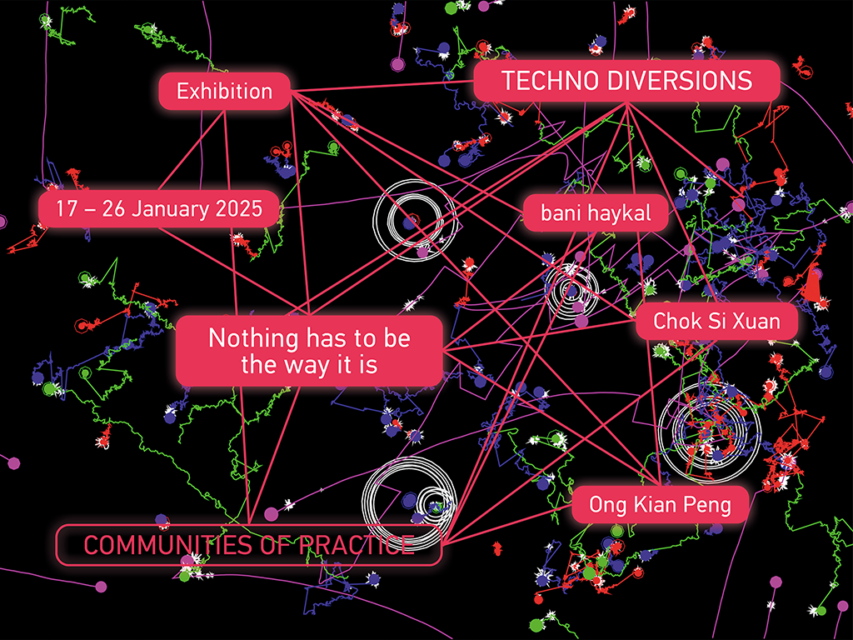
Exhibition from 17 to 26 January 2025
NTU Centre for Contemporary Art Singapore is pleased to present Nothing has to be the way it is, an exhibition featuring the artistic propositions created by Chok Si Xuan, bani haykal, and Ong Kian Peng as part of their involvement in Communities of Practice. Techno Diversions, a five-month programme curated by Anna Lovecchio that interlaces artistic research, transdisciplinary encounters, and the formation of communities around shared interests to propel transformative understandings of technology.
The uncanny symbiosis between humans and the digital devices, interactive interfaces, online platforms, and global infrastructures that increasingly operate our lives is a defining feature of contemporary society. In these wired times of machine intelligence and computational acceleration, microchip wars and platform powers, the artworks featured in this exhibition cast a sideway look at techno-driven progress. Moving across different conceptual frameworks and a multiplicity of mediums, Chok Si Xuan, bani haykal, and Ong Kian Peng share a common investment in reclaiming agency within the technosphere. They divert, possess, possibly disrupt the undisturbed existence of technological artefacts through gestures that question the escalation of technological sovereignty and, ultimately, the role of technology in our lives. Purposefully, these artists do not position themselves at the edge of advanced technologies. Rather, they interfere with existing apparatuses and instil into them worldviews other than those that originally brought them about. The systems they envisioned proceed by appropriations and approximations, frictions and forays, scrambled codes and enigmatic conjectures. In the essay “It Doesn’t Have To Be the Way It Is” which inspired the title of this exhibition, Ursula K. Le Guin remarks that the subversive power of the imagination “gnaw(s) at the very foundation of the belief that things have to be the way they are”. Nothing has to be the way it is hints at the endless permutations of how things can be.
Nothing has to be the way it is will take place in The Hall, NTU CCA Singapore’s programme space nestled at the heart of the Research Centre and launched in September 2024. This event marks the first time The Hall hosts a group exhibition, bringing home the Centre’s longstanding commitment to dwell upon and experiment with the spaces of the curatorial.
As participants in Communities of Practice. Techno Diversions, Chok Si Xuan, bani haykal, and Ong Kian Peng are conducting a residency at NTU CCA Singapore from October 2024 to February 2025. Revolving around critical engagements with the material, political, and spiritual layers of technology and the complexity of our relation to it, this multidimensional programme is a generative platform that provides artists with time, space, and resources to unravel their aesthetic inquiries and catalyse communities around their interests and creative processes.
The exhibition is couched between two series of public programmes— Empirical Workshops and the Transdisciplinary Lectures—developed in conversation with the artists themselves. Steeped in a do-it-yourself ethos, the Empirical Workshops took place in December 2024. Each workshop germinated by the artist’s own research and was aimed at creating knowledge through skill-sharing and the creative dabbling with raw materials. In Temporal Oscillations, Chok Si Xuan dived into the physics of circuitry and erratic electronics, teaching participants how to assemble common electronic components to modulate the flow of electricity and hijack standard systems of temporality. With METAL MACHINE MISCHIEF (or how to make noise music with bicycles), bani haykal took his workshop participants on an unconventional group ride. Through tinkering and drilling, cranking and whirring, discarded bicycle parts were assembled into unorthodox musical instruments activated in a final jam session that produced a one-of-a-kind audiovisual experience. Different wavelenghts resonated in Ong Kian Peng’s Natural Radio workshop where participants could explore a range of low frequency waves emitted by natural electromagnetic phenomena as a way to tune in to the inaudible voices of the environment.
Coming up in February 2025, the Transdisciplinary Lectures will bring the artists in conversations with philosophers, sociologists, scientists, and other creatives whose work significantly inspired them. Deepening the ramifications of their research in different disciplines, the Transdisciplinary Lectures will feature contributions by: Tiziano Bonini (Associate Professor, Sociology of Culture and Communication, University of Siena, Italy), Eugene Yew Siang Chua (Nanyang Assistant Professor of Philosophy, School of Humanities, NTU, Singapore), Lee Pooi See (Professor, School of Materials Science and Engineering, NTU, Singapore), Emiliano Treré (Beatriz Galindo Distinguished Professor, Language Theory and Communication Sciences, University of Valencia, Spain and Reader, Data Agency and Media Ecologies, Cardiff University, United Kingdom), and Boedi Widjaja (interdisciplinary artist, Singapore).
17 to 26 January 2025
Opening hours
Tuesday to Sunday, 12:00 – 7:00pm
Friday 24 and Saturday 25 January, 12:00 – 10:00pm
Closed on Monday
Curator Tours
Saturday 18 January, 3:00pm and 5:00pm
Artists Tour
Saturday 25 January, 3:00 – 4:00pm
The Hall
NTU CCA Singapore
Block 6 Lock Road, #01-09
Gillman Barracks, 108934
Part Of

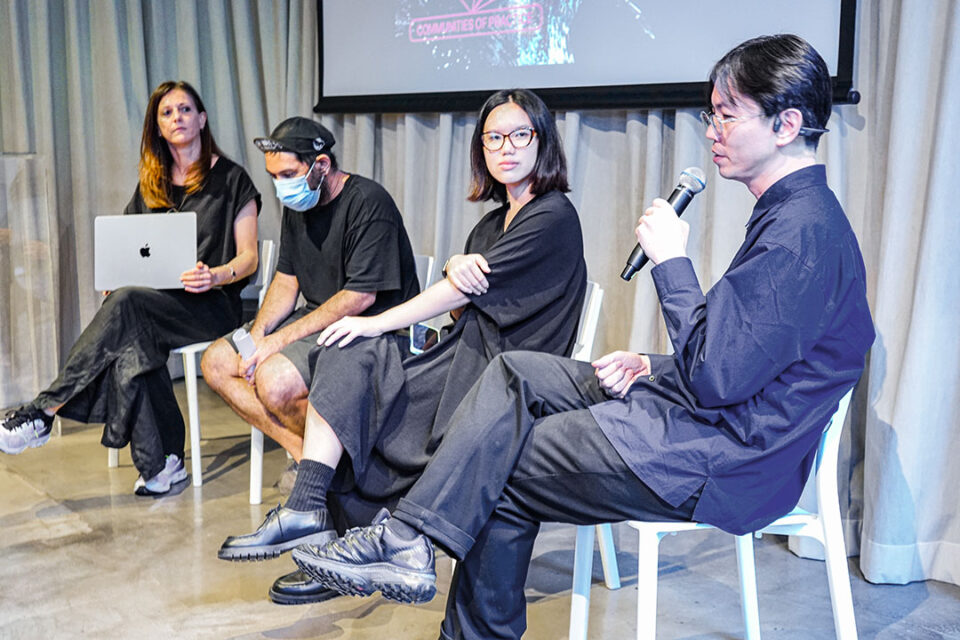
by Chok Si Xuan, bani haykal, and Ong Kian Peng
What drives an artist to reconfigure the inner mechanisms of devices we have grown increasingly reliant upon? What acts of mobilisation can an artist perform within existing technological infrastructures to cultivate different types of cultural, social, and emotional agency? Can the artistic imagination interrogate the spiritual dimensions of technology and respond to escalating environmental crises determined by society’s current course of development?
In this joint talk, artists Chok Si Xuan, bani haykal, and Ong Kian Peng reflect upon how these and other similar questions have oriented recent developments in their practices. By addressing structural opacities and power structures, and by fostering an ecological understanding of the relation between humans and technology, their work illuminates some dark corners of fast-paced technological advancement and experiments with alternative forms of being within existing structures. Their research is currently unfolding within the framework of Techno Diversions, the inaugural iteration of NTU CCA Singapore’s research platform Communities of Practice.
Communities of Practice fosters interdisciplinary collaborations and the coming together of communities around shared interests. It situates NTU CCA Singapore as an interdisciplinary body within the research-driven core of Nanyang Technological University, advancing its role as convener, capacity builder, and leading incubator in the arts sector.
Saturday, 9 November 2024, 3.00 – 4.30pm
The Hall, NTU CCA Singapore
Block 6 Lock Road, #01-09
Gillman Barracks, 108934
EMPIRICAL WORKSHOPS
This workshop will introduce participants to natural radio. Natural radio is the emission of Very Low Frequency (VLF) and Extremely Low Frequency (ELF) radio waves due to electromagnetic energy from natural phenomena. These emissions originate terrestrially from lightning and from the Sun’s interactions with the Earth’s magnetosphere, they are among the inaudible voices of the environment. If the low frequencies of these electromagnetic outbursts are transformed into acoustic waves, many of these signals may fall within the range of human hearing. Experiencing electromagnetic waves as acoustic waves will allow listeners to connect with the beauty and complexity of natural radio waves in a unique aural experience.
By the end of the workshop, participants will be able to assemble an analogue handheld radio device that tunes in to natural radio frequencies.
Participants are encouraged to bring their own headphones with a 3.5mm audio jack, along with an optional audio recorder to capture and share their auditory discoveries.
This workshop is part of the Empirical Workshop Series of Communities of Practice. Techno Diversions.
This workshop is suitable for age 18 and above.
No prior knowledge of electronics is required.
Saturday, 21 December 2024, 2 – 5pm
The Hall, NTU CCA Singapore
Block 6 Lock Road, #01-09
Gillman Barracks, Singapore, 108934
METAL MACHINE MISCHIEF (or how to make noise music with bicycles) by bani haykal
“Riding bikes ain’t s#!+ without climate justice, without land back, without liberation of everybody”
Christina Torres, Cyclista Zine
The bicycle is more than just a means of transportation. In our increasingly car-centric and carbon-heavy lifestyle, cycling is a climate action that slows down the rate at which our planet is burning. Inspiring stories from Gaza have shown us how bicycles can be radically repurposed into washing machines, sewing machines, and even power generators.
In the first part of the workshop, participants will be offered a set of unused bicycle components gathered by artist bani haykal and they will be guided to devise and conceptualise new musical or sonic instruments with them. In the second part, these unorthodox instruments will be played in a group jam session!
Participants are encouraged to bring personal items such as mallets, drumsticks, clarinet mouthpieces, and/or any musical bobs and bits they can incorporate into the instruments.
This workshop is part of the Empirical Workshop Series of Communities of Practice. Techno Diversions.
This workshop is suitable for age 18 and above.
No prior knowledge or experience is required.
Saturday, 7 December 2024, 10:30am – 12:30pm
The Hall, NTU CCA Singapore
Block 6 Lock Road, #01-09
Gillman Barracks, Singapore, 108934
Temporal Oscillations. Electronics workshop led by artist Chok Si Xuan
This workshop will explore how to use common electronic components to modulate the flow of electricity, assemble and hijack standard systems of temporality. Participants will learn how a 555 timer integrated circuit (IC) forms an astable multivibrator. The 555 timer IC is a tiny chip found in many everyday devices—blinking LED lights, kitchen timers, alarm systems, sound makers, etc.—that modulates the frequencies of electrical signals. The term ‘astable’ means ‘not stable’ because the circuit never settles into a single state, is a basic electronic circuit that generates a continuous oscillating output, switching between two voltage levels.
Working with pre-assembled circuits created by artist Chok Si Xuan, participants will be able to experiment with various components (small motors, LED lights, and speakers, etc) as outputs. Exploring the transformation of different forms of energy—chemical energy from batteries, mechanical energy , kinetic energy and byproduct thermal energy, the workshop accesses materiality as a manner of understanding the fundamental ways systems unfold.
Through engaging with electronic circuits in a hands-on and accessible way, participants can expect to develop a direct understanding of some visible and less visible aspects that power everyday technology. Participants are encouraged to bring their own components for experimentation. These may include battery-operated toys, LED lights or small light strips, buzzers or small speakers, direct current (DC) motors, small fans, switches or buttons, old electronic parts like sensors or wires, and similar items.
This workshop is part of the Empirical Workshop Series of Communities of Practice. Techno Diversions.
This workshop is suitable for age 18 and above.
No prior knowledge of electronics is required.
Saturday, 7 December 2024, 10:30am – 12:30pm
The Hall, NTU CCA Singapore
Block 6 Lock Road, #01-09
Gillman Barracks, Singapore, 108934

Transdisciplinary Lectures
Presentations by Dr Eugene Chua (Singapore) and Boedi Widjaja (Indonesia/Singapore) followed by a conversation with ong kian peng (Singapore)
What is reality? The models we use to conceptualise the world are increasingly under scrutiny, reshaped by the ecological crises of our time and the revelations of quantum theories. Classical distinctions between humans, non-humans, and objects are dissolving as we zoom in at the quantum level, revealing a world of entanglements and uncertainties. This event brings together artist Boedi Widjaja, whose practice explores the intangible and ephemeral, and philosopher of physics Eugene Chua, whose work delves into the complexities of quantum mechanics. Their presentations will be followed by a dialogue moderated by artist ong kian peng. The panel will unfold some intersections of art, science, and philosophy, offering new perspectives on how we perceive, construct, and engage with reality. Through this exchange, the audience will be offered new lenses for understanding the world and reimagine their place within a dynamic, interconnected cosmos.
Wednesday, 12 February 2025
7 – 8:30pm
The Hall, NTU CCA Singapore
Block 6 Lock Road, #01-09
Gillman Barracks, Singapore, 108934
Lecture by Professor Pooi See Lee (Singapore), followed by a conversation with artist Chok Si Xuan (Singapore)
Will electronics become flexible and soft? As technological advances shrink systems and transition from hard robots to soft machines, how will this affect the way we understand and relate to the devices we interact with?
Professor Lee Pooi See, whose research delves into human-machine interface, hybrid materials for soft robotics, and nanostructures, will share about the influences and current trajectories of material sciences and human-machine interfaces articulating her insights into the future of a softer and smaller world of technology. In conversation with Chok Si Xuan, the scientist and the artist will discuss the implications of a world driven by mechanisms that escape human vision and they will exchange ideas about the relational qualities of interfaces and the rise of biomimicry in the realm of technological innovation.
This event is generated by Chok Si Xuan within Communities of Practice. Techno Diversions, a research programme that aims to propel a transformative understanding of technology through artistic practices and transdisciplinary encounters.
Wednesday, 19 February 2025
7 – 8:30pm
The Hall, NTU CCA Singapore
Block 6 Lock Road, #01-09
Gillman Barracks, Singapore, 108934
Algorithms of Resistance. Tracing tactics of agency and solidarity within platform society
Online lecture by Tiziano Bonini (Italy) and Emiliano Treré (Italy/United Kingdom) followed by a conversation with bani haykal (Singapore)
oday, a growing number of social interactions, economic transactions, political engagements, and affective relations are enabled and regulated by a global network of online platforms operated through algorithms. As algorithmic infrastructures become enmeshed in the fabric of society, more and more aspects of everyday life are being captured and released in data streams that feed digital entities unilaterally coded and controlled by profit-driven tech companies. Through extensive online and offline fieldwork conducted across the Global North and the Global South, Tiziano Bonini and Emiliano Treré—co-authors of Algorithms of Resistance. The Everyday Fight Against Platform Power (The MIT Press, 2024)—ventured into uncharted alghoritmic territories. They encountered forms of agency, practices of resistance, and bonds of solidarity enacted by users who negotiate their own terms of existence within the platform regime. In this lecture, the speakers will reflect on how grassroots practices can spark emancipatory frictions that reinvent and disrupt the uneven power relation between users and platforms.
This event is generated by bani haykal within Communities of Practice. Techno Diversions, a research programme that aims to propel a transformative understanding of technology through artistic practices and transdisciplinary synergies.
Wednesday, 26 February 2025
7 – 8:30pm
The Hall, NTU CCA Singapore
Block 6 Lock Road, #01-09
Gillman Barracks, Singapore, 108934
As an artist and musician, bani haykal (b. 1985, Singapore) experiments with language, sound, and fiction. His work revolves around human-machine relationships / intimacies, and cultural identity formations reflecting critically on how language, tools and technologies have shaped and continue to shape our life experiences. From interfaces to interactions, from fictions to frictions, from commuting to communicating, the creative output of his research often involves the creation of DIY tools and it encompasses site-responsive installations, poetry, and performance as well as publications and music releases. He has participated in various festivals and exhibitions including Busan Biennale (South Korea, 2024), Seeing Sound (touring exhibiton, 2023 -2027), The Rumbling In-between with ila (Jendela Visual Arts Space, Esplanade, Singapore, 2023), [Alternate / Opt] Realities, State of Motion (Singapore, 2021) among many others. He has been a member of several music bands including B-Quartet, Erik Satay & The Kampong Arkestra, and The Observatory.
In some religious traditions, techniques of spiritual mapping and warfare are employed to identify ‘territorial spirits’ (demons) in specific locations and to fight their malignant influences. In visualising the historical manifestations of these spiritual beliefs within the social and physical fabric of the city, the artist aims to adopt an autoethnographic angle and to create a layered, subjective framework wherein multimedia expressions, such as performance, installation, moving image, and sound, interrogate practices of demonisation and the dichotomy between the demon/the demonised.
This episode features a conversation between two multidisciplinary creatives who are also previous collaborators: Artist-in-Residence Zachary Chan and Singaporean playwright Joel Tan. The two come together for a fascinating exchange revolving around Zachary’s research into the religion he grew up with, Pentecostal Christianity, as well as the practice of spiritual mapping and strategic-level spiritual warfare. This research thread unraveled out of Restless Topographies, a project they developed together during a residency at the Goethe Institute Singapore last year. Throughout the conversation, they weave together personal experiences, insights, and revelations, with discussions of the historical anecdotes and religious texts that Zachary has been poring over during his time in residence at NTU CCA Singapore. They also contemplate upon Zachary’s proclivity for collaborations and how the residency has afforded him time to focus on his solo artistic practice.
Spanning several mediums, the work of Zachary Chan reflects his composite background in visual communications, graphic design, and sonic arts. His practice often unfolds through collaborations with other artists and he has written music and designed sound for experimental films, theatre plays, video games, storytelling, and art installations.
Joel Tan is a writer and performer based between London and Singapore. His interdisciplinary practice examines the ways in which politics distort the personal and spiritual, exploring subjects ranging from colonial history, nature, queer experience, and contemporary Singapore life.
Contributors: Zachary Chan, Joel Tan
Editor: Anna Lovecchio
Programme Manager: Nadia Amalina
Sound Engineer: Ashwin Menon
Intro & Outro Music: Yuen Chee Wai
Cover Image & Design: Arabelle Zhuang, Kristine Tan
Spanning several mediums, the work of Zachary Chan’s (b. 1990, Singapore) reflects his composite background in visual communications, graphic design, and sonic arts. His practice often unfolds through collaborations with other artists and he has written music and designed sound for experimental films, theatre plays, video games, storytelling, and art installations. His most recent solo work was part of the group exhibition Inheritance of Parts, Starch, Singapore (2021). Among his major collaborative projects are Restless Topographies, with Joel Tan and Zarina Muhammad (2021-2022); earth, land, sky and sea as palimpsest with Zarina Muhammad (2021); Pokoknya: Intrusive Transducers, with Tini Aliman (2021); and The Migrant Ecologies Project, with Lucy Davis (2017–ongoing). He is also a co-founder of the design collective crop.sg.
Completed during the residency, Russell Morton‘s latest short film revolves around the eclectic and versatile figure of Mohammad Din Mohammad (1955 – 2007). Artist and mystic, traditional healer and idiosyncratic collector of Southeast Asian cultural items, Mohammad Din Mohammad was also an actor and a silat master. Playfully disclosing the production limitations imposed by the pandemic, the film evokes Mohammad’s multifaceted personality through the faces, voices, and memories of the artist’s family members and an experimental process where affects and sounds are mediated by technology. As it unfolds, the film grows into an upbeat stream of visuals and sounds mixed by Momok, a computer algorithm created by artist bani haykal.
Mystic & Momok was commissioned by National Gallery Singapore for the exhibition Something New Must Turn Up: Six Singaporean Artists After 1965 (7 May – 22 August 2021) which featured Mohammad Din Mohammad’s works.
This event marks the opening of The Screening Room, NTU CCA Singapore’s cosy new space dedicated to film screenings and talks.
This event is part of Residencies OPEN, 18 September 2021 (1.00 – 7.00pm), for more info click here.
Image: Mystic & Momok, 2021, HD (16:9), video, stereo, 18min 10sec. Courtesy of the artist.
Come by the studios of our Artists-in-Residence: Tini Aliman and Russell Morton (both Singapore) for a special insight into their artistic process. This session of Residencies OPEN will allow you to encounter works-in-progress, watch a film screening, browse archival materials, and talk to the artists in person!

TINI ALIMAN
Open Studio
Saturday, 18 September, 1:00 – 7:00 pm
Block 37 Malan Road, #01-03
no registration required
As a new development of her long-term research on plant consciousness and biodata sonification, Tini Aliman has come to regard ‘dead’ trees as potential archives of environmental soundscapes, witnesses of urban development and extractive capitalism, ecological events and climate change. Breathing new life into tree stumps, fragments of felled trees, and repurposed wood from previous artworks, the artist is reconfiguring these materials into kinetic and sound sculpture prototypes and she is experimenting with a range of sensory and mechanical modes of activation. Conjunctly, inspired by the structural and functional similarities between Printed Circuit Board (PCB) etching designs and forest underground network ecosystems, Tini is also speculatively imagining a functioning network of closed electronic circuits that mimics how these trees would have communicated while they were still alive. This project is realised in collaboration with Trying.sg.
Working at the intersection of film, sound, theatre, and installation, often through collaborative projects, the sonic and spatial experiments of Tini Aliman (b. 1980, Singapore) focus on forest networks, plant consciousness, bioacoustics, and data translations via biodata sonification. Her recent projects and collaborations have been presented at Free Jazz III: Sound. Walks. NTU CCA Singapore (2021); An Exercise of Meaning in a Glitch Season, National Gallery Singapore (2020); Sound Kite Orchestra, Biennale Urbana, Venice, Italy and Stories We Tell to Scare Ourselves With, Museum of Contemporary Art Taipei, Taiwan (both 2019).
–

RUSSELL MORTON
Open Studio
Saturday, 18 September, 1:00 – 7:00 pm
Block 37 Malan Road, #01-02 & Block 38 Malan Road, #01-06
no registration required
For the past six months, Russell Morton has dived deep into gathering research materials and audiovisual references for the script of his first feature film. Inspired by a not well-known historical event—a prison riot which took place in Pulau Senang before Singapore’s independence—, the film interweaves the horrific events of the bloody riot with regional folklore. This open studio session presents a generous selection of archival materials, oral histories, and sound recordings relevant to the development of the script as well as the documentation (shot on Super 8mm film) of the artist’ site visits to a kelong, a type of vernacular architecture on the verge of disappearing that will feature prominently in the film.
Furthermore, there will be the opportunity to watch Morton’s most recent short film Mystic and Momok (2021), see below for more details.
The filmic and performative practice of Russell Morton (b. 1982, Singapore) explores folkloric myths, esoteric rituals, and the conventions of cinema itself. His film Saudade (2020) was commissioned for State of Motion: Rushes of Time, Asian Film Archives, Singapore, and presented at the 31st Singapore International Film Festival (2020); The Forest of Copper Columns (2015) won the Cinematic Achievement Award at the 57th Thessaloniki Film Festival, Greece (2016) and was selected for several festivals including the Short Shorts Film Festival, Tokyo, Japan (2017), the Thai Short Film and Video Festival, Bangkok, Thailand, and Jogja-NETPAC Asian Film Festival, Indonesia (both 2016).
–
RESIDENCIES INSIGHTS

RUSSELL MORTON: ARTIST-LED STUDIO TOUR
Saturday, 18 September, 3:00 – 3:45pm
Block 37 Malan Road, #01-02
In this artist-led studio tour, Russell Morton will talk about his references and unpack some of the research materials that will be woven into the structure of his first feature film: a dark narrative of drifting away from crime and floating in punishment inspired by a grim historical episode which happened in Singapore in the early 1960s.
Due to safe-distancing measures, this event has limited capacity and is by registration only. Please register here.

TINI ALIMAN: OF UNDERGROUND SCHEMATICS & THE FALLEN TREE
Artist Talk and Performance
Saturday, 18 September, 4:30 – 5:30pm
Block 37 Malan Road, #01-03
In a two-part event consisting of a talk and a performance, Tini Aliman will share her findings and reflections on plant consciousness and on the parallels between the human and the vegetable sensorium, interweaving them with explorations in acoustic memory and sonic symbolism related to her personal musical journey. In the performance, she will engage with her long-standing collaborator, a ficus microcarpa (Malayan banyan tree) named Ara.
Due to safe-distancing measures, this event has limited capacity and is by registration only. Please register here.

MYSTIC & MOMOK BY RUSSELL MORTON
Film Screening (on loop)
HD video (16:9), stereo, 18min 10sec, 2021
Rating: PG
Saturday, 18 September, 1:00 – 7:00pm
The Screening Room
Block 38 Malan Road, #01-06
No registration required. Please expect waiting time if room capacity is reached.
Completed during the residency, Russell Morton’s latest short film revolves around the eclectic and versatile figure of Mohammad Din Mohammad (1955 – 2007). Artist and mystic, traditional healer and idiosyncratic collector of Southeast Asian cultural items, Mohammad Din Mohammad was also an actor and a silat master. Playfully disclosing the production limitations imposed by the pandemic, the film evokes Mohammad’s multifaceted personality through the faces, voices, and memories of the artist’s family members and an experimental process where affects and sounds are mediated by technology. As it unfolds, the film grows into an upbeat stream of visuals and sounds mixed by Momok, a computer algorithm created by artist bani haykal.
Mystic & Momok was commissioned by National Gallery Singapore for the exhibition Something New Must Turn Up: Six Singaporean Artists After 1965 (7 May – 22 August 2021) which featured Mohammad Din Mohammad’s works.
This event marks the opening of The Screening Room, NTU CCA Singapore’s cosy new space dedicated to film screenings and talks.
Ghosts and Spectres — Shadows of History features video installations and films by Apichatpong Weerasethakul (Thailand), Ho Tzu Nyen (Singapore), Nguyen Trinh Thi (Vietnam), and Park Chan-kyong (South Korea). The artists’ research into their own cultural and historical backgrounds gain shape through allegories that re-evaluate the social and political reforms in Post-War and Cold-War Asia. The cinematic works in the exhibition combine fact and fiction. They not only allude to rarely discussed subject-matters but also raise crucial questions about power and authority, construction of narratives, repression of identities, and collective trauma.
Embedded in the vernacular, ghosts, myths, and rituals present systems of knowledge that enable the expression of unknown worlds. Ghosts and Spectres — Shadows of History brings to light clouded histories at times not officially recounted but those that remain a lingering presence in collective memories through local mythologies, ghostly figures, and traditions. The works create their own language and systems of reference, reflecting current efforts of exposing written historical accounts and contemporary situations that subvert mainstream narratives.
In parallel, The Lab, NTU CCA Singapore’s platform for research in-progress, will be featuring projects by siren eun young jung (South Korea) and Choy Ka Fai (Singapore/Germany), both recent NTU CCA Singapore artists-in-residence. While jung focuses on Yeoseong Gukgeuk, a vanishing form of traditional Korean theatre featuring only female performers, Choy brings up his long-time research into Butoh dance, also called “dance of darkness,” and looks at its evolution and influence through one of the Butoh founders, Tatsumi Hijikata.
Ghosts and Spectres—Shadows of History is curated by Ute Meta Bauer, Founding Director, NTU CCA Singapore, and Professor, School of Art, Design and Media, NTU, and Khim Ong, Deputy Director, Curatorial Programmes.
The NTU Centre for Contemporary Art Singapore is honoured to present They Come to Us without a Word, video and performance pioneer Joan Jonas’ first large-scale exhibition in Singapore and Southeast Asia. They Come to Us without a Word was organised for the U.S. Pavilion of the 56th Venice Biennale by the MIT List Visual Arts Center and co-curated by Paul C. Ha, Director of the MIT List Visual Arts Center and Ute Meta Bauer, Founding Director of the NTU Centre for Contemporary Art Singapore. With this exhibition Jonas evokes the fragility of nature, using her own poetic language to address the irreversible impact of human interference on the environmental equilibrium of our planet.
Acknowledgements They Come to Us without a Word was organised for the U.S. Pavilion of the 56th Venice Biennale by the MIT List Visual Arts Center and co-curated by Paul C. Ha, Director of the MIT List Visual Arts Center and Ute Meta Bauer, Founding Director of the NTU Centre for Contemporary Art Singapore. The exhibition was generously supported by U.S. Department of State, Cynthia and John Reed, the Helen Frankenthaler Foundation, and the Massachusetts Institute of Technology. Additional major support was provided by the Council for the Arts at MIT, Toby Devan Lewis, VIA Art Fund, Agnes Gund, Lambent Foundation.
The exhibition in Singapore is organised by the NTU Centre for Contemporary Art Singapore, Nanyang Technological University with support by the Economic Development Board, Singapore. Additional support has also been provided by the U.S. Embassy Singapore.
Zarina Muhammad (b. 1982, Singapore) is an artist, educator, and researcher whose practice critically re-examines oral histories, ethnographic literature, and historiographic narratives of Southeast Asia. Working at the intersections of performance, text, installation, ritual, sound, moving image, and participatory practice, her work explores the enmeshed contexts of ecocultural cosmologies, identities and interactions, mythmaking, haunted historiographies, and geo-spirited landscapes. Her long-term interdisciplinary project investigates Southeast Asia’s evolving relationship with spectrality, ritual magic, polysensoriality, and the immaterial, examining these themes against the backdrop of global modernity, the social production of rationality, and transcultural exchanges of knowledge. Her work has been widely presented at international biennales and institutions, including FotoFest Biennial, Houston, USA (2024), the 2nd Diriyah Contemporary Art Biennale, Saudi Arabia (2024), the 7th Singapore Biennale (2022), and the 3rd Lahore Biennale, Pakistan (2024). She recently had a solo presentation, curated by Shubigi Rao, at the Singapore Pavilion at the 15th Gwangju Biennale, South Korea (2024). Zarina is the recipient of the 2022 IMPART Art Prize.