Centered around the theme of biocultural worlding, these keynote lectures will explore the processes that shape our understanding of the world through the deep interconnections between cultural and biological life. Dr Lisa Onaga, Senior Research Scholar at the Max Planck Institute for the History of Science, will reflect on the intersections of biological materiality, cultural practice, and the authorship of knowledge. Curator and researcher Dr Margarida Mendes will explore the concept of worlding from the ocean point of view. This lecture foregrounds ecosystemic, political and ontological relations across aquatic realms. It introduces ongoing research and activism on ecoacoustics, deep sea mining, and remote sensing, proposing how different modes of ocean monitoring may contribute to plural oceanic worldings and alliances in the making. Together, their lectures will illuminate how Biocultural Worlding unfolds across land and sea, and how attending to these entanglements opens new ways of imagining collective futures in times of environmental and epistemic loss.
22 September 2025
6:30pm – 8:00pm
The Hall, NTU CCA Singapore
What is ‘Worlding’ in Biocultural Worlding? is supported by CLASS JOINT NTU-ANU NTU-KCL CONFERENCE, SYMPOSIUM, AND WORKSHOP SCHEME.
NTU Centre for Contemporary Art Singapore (NTU CCA Singapore) presents the two-part research presentation Climate Crisis and Cultural Loss. First unfolding at TBA21–Academy’s Ocean Space in Venice, Italy, the research inquiry later materialises in another configuration at ADM Gallery, a university gallery under the School of Art, Design, and Media (NTU ADM) at Nanyang Technological University Singapore.
This twofold exhibition marks the conclusion of the eponymous research project led by Principal Investigator Ute Meta Bauer at NTU ADM. The inquiry started by asking: how has the slow erosion of diverse, multicultural, and more-than-human ways of living over time impacted the environments in which we live, and what are the longer-term consequences on habitats? Can we begin again with culture, to induce a necessary paradigm shift in the way we think about and respond to the climate crisis? Extending connections and conversations seeded during the inaugural cycle of TBA21–Academy’s The Current fellowship programme led by Bauer from 2015 to 2018, Climate Crisis and Cultural Loss continues to build archipelagic networks across the Alliance of Small Island Developing States, deepening existing collaborations with Oceania Centre for Arts, Culture and Pacific Studies in Fiji, and developing new ones further in the South Pacific Ocean, through the art and media non-profit organisation Further Arts in Vanuatu.
Bridging conversations from the Pacific to Singapore in the Riau Archipelago, former fellows of TBA21–Academy’s The Currentand current research collaborators artist Nabil Ahmed, social anthropologist Guigone Camus, artist Kristy H.A. Kang, legal scholar Hervé Raimana Lallemant-Moe, and artists Armin Linke and Lisa Rave, join Singapore-based researchers Co-Investigator Sang-Ho Yun and Denny Chee of the Earth Observatory of Singapore – Remote Sensing Lab (EOS–RS) and the Asian School of the Environment, NTU ADM research staff Soh Kay Min and Ng Mei Jia, historian Jonathan Galka, and community organiser Firdaus Sani, as they explore the impacts of extreme weather, rising seas, climate displacement, ocean resource extraction, and the disappearance of material cultural traditions, occurring across what the visionary Pacific thinker Epeli Hau’ofa has termed “our sea of islands.” Featuring interviews, data visualisations, documentation, writings, and artisanal crafts made in collaboration with or generously gifted to the research team by knowledge bearers, community leaders, scientists, scholars, and artists, including writer and curator Frances Vaka’uta, masi artist Igatolo Latu,human rights defender Anne Pakoa and anthropologist Cynthia Chou, the exhibitions present the rich, complex, and multi-layered research findings accumulated over three years, since the Climate Crisis and Cultural Loss project first started in 2021.
At TBA21–Academy’s Ocean Space, the Climate Crisis and Cultural Loss research inquiry sits adjacent to the exhibition Restor(y)ing Oceania, comprising two new site-specific commissions by Latai Taumoepeau and Elisapeta Hinemoa Heta. Curated by Bougainville-born artist Taloi Havini, whose curatorial vision is guided by an ancestral call-and-response method, the exhibition materialises as a search for solidarity and kinship in uncertain times, in order to slow down the clock on extraction and counter it with reverence for the life of the Ocean.
At ADM Gallery, Climate Crisis and Cultural Loss is presented alongside the companion show Sensing Nature, curated by Gallery Director Michelle Ho. The exhibition showcases artists representing diverse disciplines, each offering their interpretation of the natural world and its intersection with urban life. Through reflection and experimentation, these works invite viewers to reassess our perceptions and behaviors toward the environment and phenomena beyond human influence. They advocate for a renewed understanding of society’s connection to nature and the land.
Climate Crisis and Cultural Loss is supported by the Ministry of Education, Singapore, under its Academic Research Fund Tier 2 grant. The research presentation at Ocean Space coincides with the 60th International Art Biennale in Venice, Italy, with public programmes taking place through the exhibition durations in both Venice and Singapore.
Opening Dates
Ocean Space exhibition preview:
March 22, 6pm
Ocean Space, Venice, Chiesa di San Lorenzo Castello
Opening hours
March 23–October 13, 2024: Wednesday to Sunday, 11am–6pm
Ocean Space
Chiesa di San Lorenzo Castello 5069, Venice
April 12–May 24, 2024: Monday to Friday, 10am–5pm
ADM Gallery
81 Nanyang Drive, Singapore 637458
Decay, decomposition, weathering, rot. Landscapes eroding, architectures disintegrating, bodies breaking down, coming apart, becoming dirt. We hardly have a kinship with decay for, like dirt, decay is—in the words of anthropologist Mary Douglas—matter out-of-place in our perpetually renewing cities. Indeed, the city we are brought to inhabit and desire is built with ever-more weatherproof architectures, with cosmetic treatments that maintain the hardness of the buildings and the smoothness of their surfaces impervious to the traces of Nature’s time. In waterfront cities, which novelist Amitav Ghosh regards as a showcase of architectural mastery over the unruly environment, the cartography of terrestrial edges continues to reinforce the separation of interiorised human-made worlds from exteriorised more-than-human environment. Seen through the lens of the city, the design of the future Earth aspires to be atemporal. And like so many transient and shifting environments stilled in human projections of the Earth (from maps to masterplans), the “unweathered” city must thrive outside of time, devoid of stains and discolouration. But does the city have to be in an anxious race against Nature’s time?
Created and led by Superlative Futures, Drawing Dialogues: Stories of Decay is a workshop for re-attuning our urban selves to Nature’s time. The programme focuses on rethinking the place of decay in the wellbeing of cities and on re-presenting stories of decay as matters of care. The workshop will start off with a walk in the Berlayer Creek—a rare remnant of Singapore’s mangrove histories once denigrated as a place of dankness and disease—where participants will be led to uncover stories of decay and gather thoughts and materials of decomposition. The second part of the workshop will take place at NTU CCA Singapore where, drawing and dialoguing with decay, participants will be guided to create their own narratives and landscapes of decay culminating in a collaborative artwork. Expanding on Superlative Futures’ speculative design research on new ecological practices for weathering the future city, this workshop marks the beginning of a propositional archive—A Cartography of Decay—that charts different relationships between decay and the city.
This event is a public programme created in response to the exhibition Design Earth: Speculative Fiction for the Climate, on view by appointment at NTU ADM Gallery 2 until 15 August 2025.
Progressive Disintegrations is a collaborative group that began out of the need to create a format and a space for creative exchange between the artistic practices of Chua Chye Teck, Marc Gloede, Hilmi Johandi and Wei Leng Tay. The project aimed to open up the normally individual artistic and curatorial pursuits of each participant, creating situations that allow them to explore and expand the notions that underlie their respective practices.
Through collaboration with EOS for the STAR RESIDENCY, Ng Hui Hsien aims to complement scientific tools and methods of environmental studies with indigenous ecological knowledge shaped by lived experience, oral traditions, and direct observation. On one hand, she will engage with materials such as satellite imagery, seismic monitoring systems, and photomicrographs to understand how Earth scientists observe and evaluate environmental changes and geohazards. On the other hand, drawing on her background in ethnography, she plans to conduct field research and engage with communities and individuals imbued with a deep connection to the environment to understand the rhythms of their lives as they unfold on site, the changes they observe, and their knowledge and cosmologies related to natural processes and phenomena. Ultimately, the artist intends to translate this research across different bodies of knowledge into artistic outcomes that deepen the awareness of ecological interconnectedness and convey a sense of reverence for nature.
Ng Hui Hsien (b. 1982, Singapore) works as an artist, educator, and curator. Through her artworks, she seeks to evoke stillness and wonder, especially towards our inner landscapes and the more-than-human world. Her work is informed by phenomenology, one that sees our bodies as sites of knowledge and one curious about our relations with the living earth. Ng has received solo exhibitions at Objectifs Centre of Photography and Film, Singapore (2023), Grey Projects, Singapore (2020-2021), Comma Space, Singapore (2020), and Reykjavík Museum of Photography, Iceland (2018-2019). Her work has been internationally exhibited at institutions and festivals such as Shanghai Art Book Fair, China (2019), Martin Parr Foundation, Bristol, UK (2018), the PhotoBangkok Festival, Thailand (2018), Obscura Festival of Photography, Penang, Malaysia (2018), Dali International Photography Festival, China (2018), and Athens Photo Festival, Greece (2018) among others. She holds a Master of Arts in Photography from University of the West of England and a Master of Social Sciences from National University of Singapore.
Ng Hui Hsien (b. 1982, Singapore) works as an artist, educator, and curator. Through her artworks, she seeks to evoke stillness and wonder, especially towards our inner landscapes and the more-than-human world. Her work is informed by phenomenology, one that sees our bodies as sites of knowledge and one curious about our relations with the living earth. Ng has received solo exhibitions at Objectifs Centre of Photography and Film, Singapore (2023), Grey Projects, Singapore (2020-2021), Comma Space, Singapore (2020), and Reykjavík Museum of Photography, Iceland (2018-2019). Her work has been internationally exhibited at institutions and festivals such as Shanghai Art Book Fair, China (2019), Martin Parr Foundation, Bristol, UK (2018), the PhotoBangkok Festival, Thailand (2018), Obscura Festival of Photography, Penang, Malaysia (2018), Dali International Photography Festival, China (2018), and Athens Photo Festival, Greece (2018) among others. She holds a Master of Arts in Photography from University of the West of England and a Master of Social Sciences from National University of Singapore.
NTU Centre for Contemporary Art Singapore is pleased to announce the launch of STAR Residencies (Science, Technology, Art & Research), a new residency programme aimed at fostering the cross-pollination between artistic and scientific research. Through partnerships with select NTU research institutes, STAR Residencies embeds artistic residencies at the core of the University, creating a unique opportunity for exchange between artists and academic researchers. A pioneering programme in the context of Singapore and Southeast Asia, STAR Residencies stems from NTU CCA Singapore’s decade-long expertise in developing innovative platforms for knowledge making, creative experimentation, and transdisciplinary collaborations.
For its inaugural cycle, STAR Residencies unfolds in partnership with NTU Earth Observatory of Singapore (EOS), a research institute of Nanyang Technological University dedicated to the scientific observation of the forces that shape our changing planet. Regarded as a leader on a broad spectrum of geosciences in the Asia-Pacific region, EOS gathers critical data and develops vital knowledge about geohazards, climate change, and their impact on human societies. This collaboration expands Centre’s long-standing research on Climates.Habitats.Environments. and its continued commitment to critical artistic practices that engage with ecological complexities, climate change, and sustainability to advance the collective awareness of planetary interconnectedness in times of environmental distress.
The artists participating in the first iteration STAR Residencies are: Ng Hui Hsien, The Observatory (Dharma, Cheryl Ong, Yuen Chee Wai), and Zarina Muhammad. They were selected from a pool of 19 candidates (nominated by experts in the field) by a Selection Committee composed of: Dr Karin Oen, Director, NTU CCA Singapore, Senior Lecturer and Head of Department, Art History, NTU School of Humanities; Lauriane Chardot, Assistant Director, Community Engagement, Earth Observatory of Singapore, NTU; and Haeju Kim, Senior Curator and Head of Residencies, Singapore Art Museum.
The first cycle of STAR Residencies takes place from April 2025 to March 2026. Within the programme’s framework, artists are granted unprecedented access to processes and methodologies of fundamental scientific research, state-of-the-art laboratories, data sets, and extensive international networks, being provided with the exceptional opportunity to immerse themselves in EOS’s dynamic scientific community wherein they can expand their intellectual horizon, explore ideas, forge new means of artistic inquiry, and engage creatively with Earth systems and ecological complexities. The programme will conclude with an exhibition in March 2026 that will showcase the research projects developed during the residency. In the words of Karin Oen, “STAR Residencies mark an important new chapter for NTU CCA Singapore in which the intersections of artistic and scientific research can thrive with the support of the broader academic community at NTU.”
With creative practices that span photography, performance, installation, and sound, the artists will conduct independent research on a variety of Earth systems, interweaving different bodies of knowledge in aesthetic outcomes that foster the awareness of ecological interconnectedness and of the complexity of human relation to nature. Drawing on her background in ethnography, Ng Hui Hsien intends to complement the scientific strategies used to evaluate environmental changes and geohazards with indigenous ecological knowledge shaped by lived experience, oral traditions, and direct observation, creating evocative insights into practices of ecological coexistence. The Observatory will expand their engagement with subterranean phenomena and geological formations. Deepening their understanding of the volcanic arcs that shape Southeast Asia and of the processes of rock formation, they will develop a project that resonates from deep time to contemporary existence. Driven by a process-led and constellatory approach to collaboration, Zarina Muhammad will engage with different scientists to expand epistemic frameworks for ecological witnessing, looking at weather formations, underwater ecologies, polycosmologies and the interdependency of environmental knowledge systems.
STAR Residencies is developed and curated by Dr Anna Lovecchio, Curator, NTU CCA Singapore.
This workshop will explore how to use common electronic components to modulate the flow of electricity, assemble and hijack standard systems of temporality. Participants will learn how a 555 timer integrated circuit (IC) forms an astable multivibrator. The 555 timer IC is a tiny chip found in many everyday devices—blinking LED lights, kitchen timers, alarm systems, sound makers, etc.—that modulates the frequencies of electrical signals. The term ‘astable’ means ‘not stable’ because the circuit never settles into a single state, is a basic electronic circuit that generates a continuous oscillating output, switching between two voltage levels.
Working with pre-assembled circuits created by the artist, participants will be able to experiment with various components (small motors, LED lights, and speakers, etc) as outputs. Exploring the transformation of different forms of energy—chemical energy from batteries, mechanical energy , kinetic energy and byproduct thermal energy, the workshop accesses materiality as a manner of understanding the fundamental ways systems unfold.
Through engaging with electronic circuits in a hands-on and accessible way, participants can expect to develop a direct understanding of some visible and less visible aspects that power everyday technology. Participants are encouraged to bring their own components for experimentation. These may include battery-operated toys, LED lights or small light strips, buzzers or small speakers, direct current (DC) motors, small fans, switches or buttons, old electronic parts like sensors or wires, and similar items.
This workshop is part of the Empirical Workshop Series of Communities of Practice. Techno Diversions.
This workshop is suitable for age 18 and above.
No prior knowledge of electronics is required.
The artistic practice of Chok Si Xuan (b. 1998, Singapore) is driven by a deep fascination for the complex relations that enmesh technology in the everyday. Exploring ways in which technology, machines, and industrial materials shape contemporary subjectivities and corporealities, her growing body of work features composite sculptures and kinetic installations that coalesce odd circuitries, feedback systems, found electronics, and material components of common technological devices. She is currently pursuing a degree in electronics engineering to gain a deeper understanding of the material nature of electronics and electricity. Her work has been shown in and commissioned by institutions such as ArtScience Museum (2024), Singapore Art Museum and Esplanade (both 2023) as well as independent art spaces in Singapore.
Image: Portrait of Chok Si Xuan. Photo by Kee Ya Ting. Courtesy NTU Centre for Contemporary Art Singapore.
Lecture by Professor Pooi See Lee (Singapore), followed by a conversation with artist Chok Si Xuan (Singapore)
Will electronics become flexible and soft? As technological advances shrink systems and transition from hard robots to soft machines, how will this affect the way we understand and relate to the devices we interact with?
Professor Lee Pooi See, whose research delves into human-machine interface, hybrid materials for soft robotics, and nanostructures, will share about the influences and current trajectories of material sciences and human-machine interfaces articulating her insights into the future of a softer and smaller world of technology. In conversation with Chok Si Xuan, the scientist and the artist will discuss the implications of a world driven by mechanisms that escape human vision and they will exchange ideas about the relational qualities of interfaces and the rise of biomimicry in the realm of technological innovation.
This event is generated by Chok Si Xuan within Communities of Practice. Techno Diversions, a research programme that aims to propel a transformative understanding of technology through artistic practices and transdisciplinary encounters.
Professor Pooi See Lee is the President’s Chair Professor in Materials Science & Engineering at Nanyang Technological University (NTU), Singapore. Her current research focuses on soft electronics and energy devices, human-machine interface, sensors and actuators, soft robotics and healthtech. Professor Lee received the Nanyang Research Award in 2016, the Nanyang Award for Innovation and Entrepreneurship Award in 2018. She was an awardee of the NRF Investigatorship 2016. She received the SNIC – AsCA2019 Distinguished Woman Chemist Award 2022. She was elected National Academy of Inventors Fellow in 2020, RSC Fellow 2022 and the MRS Fellow 2022.
The first iteration of NTU CCA Singapore’s new research platform, Communities of Practice. Techno Diversions convenes three Singaporean artists—Chok Si Xuan, bani haykal, and Ong Kian Peng—whose practice engage with the material, cultural, and emotional layers of technology, its evolving role in contemporary life, and the complexity of our relation to it. As a multidimensional platform that entwines artistic research, experimentation, and the formation of communities across shared interests, Techno Diversions aims to propel a transformative understanding of what technology is through the lens of artistic practices that pursue the renewal of our agency within the technosphere and the re-enchantment with its tools. In an increasingly techno-driven society, these artists embrace the urgency to think critically about the conceptual parameters and material manifestations of technological progress charting new paths of significance by creative acts of repurposing, disrupting, and re-envisioning commonly accepted ideas and existing devices.
As participants in the programme, the artists are offered a five-month residency at the NTU CCA Singapore Research Centre from October 2024 to February 2025 and the agency to shape a research framework in ways that are conducive to the advancement of their practice. The research framework may entail seminars, screenings, peer-oriented sessions, workshops or other programmes engaging interlocutors from various fields. Oriented towards the production and circulation of knowledge, these gatherings will be organised in close collaboration with the participating artists with the goal to unravel their aesthetic inquiries while also catalysing communities and propelling public discourse around the subjects and methodologies of their research.
The programme will culminate with the production of new artworks that will be presented in an exhibition at NTU CCA Singapore during the Singapore Art Week 2025 (17 – 26 January 2025).
Communities of Practice. Techno Diversionsis curated by Dr Anna Lovecchio, Curator, Programmes.
About Communities of Practice
Conceived as seedbed for experimentation, Communities of Practice is a shapeshifting research platform that brings forth communities at the intersection of artistic practices. Holding a communal space where artistic research can develop through interdisciplinary collaborations, exchanges, and processes of co-creation, Communities of Practice situates NTU CCA Singapore within the research-driven core of Nanyang Technological University by configuring the Centre as an interdisciplinary body and advancing its role as convener, capacity builder, and leading-edge incubator in the arts sector.
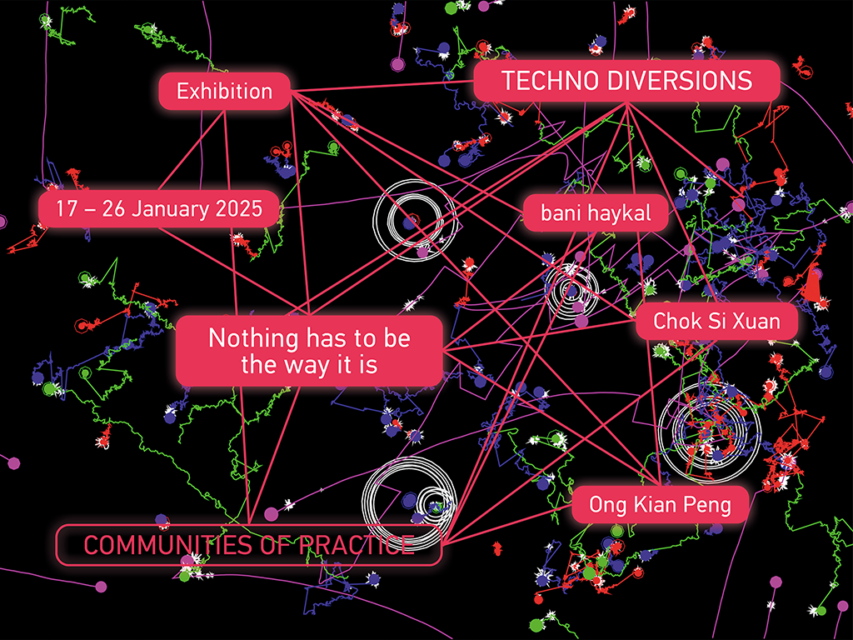
Exhibition from 17 to 26 January 2025
NTU Centre for Contemporary Art Singapore is pleased to present Nothing has to be the way it is, an exhibition featuring the artistic propositions created by Chok Si Xuan, bani haykal, and Ong Kian Peng as part of their involvement in Communities of Practice. Techno Diversions, a five-month programme curated by Anna Lovecchio that interlaces artistic research, transdisciplinary encounters, and the formation of communities around shared interests to propel transformative understandings of technology.
The uncanny symbiosis between humans and the digital devices, interactive interfaces, online platforms, and global infrastructures that increasingly operate our lives is a defining feature of contemporary society. In these wired times of machine intelligence and computational acceleration, microchip wars and platform powers, the artworks featured in this exhibition cast a sideway look at techno-driven progress. Moving across different conceptual frameworks and a multiplicity of mediums, Chok Si Xuan, bani haykal, and Ong Kian Peng share a common investment in reclaiming agency within the technosphere. They divert, possess, possibly disrupt the undisturbed existence of technological artefacts through gestures that question the escalation of technological sovereignty and, ultimately, the role of technology in our lives. Purposefully, these artists do not position themselves at the edge of advanced technologies. Rather, they interfere with existing apparatuses and instil into them worldviews other than those that originally brought them about. The systems they envisioned proceed by appropriations and approximations, frictions and forays, scrambled codes and enigmatic conjectures. In the essay “It Doesn’t Have To Be the Way It Is” which inspired the title of this exhibition, Ursula K. Le Guin remarks that the subversive power of the imagination “gnaw(s) at the very foundation of the belief that things have to be the way they are”. Nothing has to be the way it is hints at the endless permutations of how things can be.
Nothing has to be the way it is will take place in The Hall, NTU CCA Singapore’s programme space nestled at the heart of the Research Centre and launched in September 2024. This event marks the first time The Hall hosts a group exhibition, bringing home the Centre’s longstanding commitment to dwell upon and experiment with the spaces of the curatorial.
As participants in Communities of Practice. Techno Diversions, Chok Si Xuan, bani haykal, and Ong Kian Peng are conducting a residency at NTU CCA Singapore from October 2024 to February 2025. Revolving around critical engagements with the material, political, and spiritual layers of technology and the complexity of our relation to it, this multidimensional programme is a generative platform that provides artists with time, space, and resources to unravel their aesthetic inquiries and catalyse communities around their interests and creative processes.
The exhibition is couched between two series of public programmes— Empirical Workshops and the Transdisciplinary Lectures—developed in conversation with the artists themselves. Steeped in a do-it-yourself ethos, the Empirical Workshops took place in December 2024. Each workshop germinated by the artist’s own research and was aimed at creating knowledge through skill-sharing and the creative dabbling with raw materials. In Temporal Oscillations, Chok Si Xuan dived into the physics of circuitry and erratic electronics, teaching participants how to assemble common electronic components to modulate the flow of electricity and hijack standard systems of temporality. With METAL MACHINE MISCHIEF (or how to make noise music with bicycles), bani haykal took his workshop participants on an unconventional group ride. Through tinkering and drilling, cranking and whirring, discarded bicycle parts were assembled into unorthodox musical instruments activated in a final jam session that produced a one-of-a-kind audiovisual experience. Different wavelenghts resonated in Ong Kian Peng’s Natural Radio workshop where participants could explore a range of low frequency waves emitted by natural electromagnetic phenomena as a way to tune in to the inaudible voices of the environment.
Coming up in February 2025, the Transdisciplinary Lectures will bring the artists in conversations with philosophers, sociologists, scientists, and other creatives whose work significantly inspired them. Deepening the ramifications of their research in different disciplines, the Transdisciplinary Lectures will feature contributions by: Tiziano Bonini (Associate Professor, Sociology of Culture and Communication, University of Siena, Italy), Eugene Yew Siang Chua (Nanyang Assistant Professor of Philosophy, School of Humanities, NTU, Singapore), Lee Pooi See (Professor, School of Materials Science and Engineering, NTU, Singapore), Emiliano Treré (Beatriz Galindo Distinguished Professor, Language Theory and Communication Sciences, University of Valencia, Spain and Reader, Data Agency and Media Ecologies, Cardiff University, United Kingdom), and Boedi Widjaja (interdisciplinary artist, Singapore).
17 to 26 January 2025
Opening hours
Tuesday to Sunday, 12:00 – 7:00pm
Friday 24 and Saturday 25 January, 12:00 – 10:00pm
Closed on Monday
Curator Tours
Saturday 18 January, 3:00pm and 5:00pm
Artists Tour
Saturday 25 January, 3:00 – 4:00pm
The Hall
NTU CCA Singapore
Block 6 Lock Road, #01-09
Gillman Barracks, 108934
Part Of

by Chok Si Xuan, bani haykal, and Ong Kian Peng
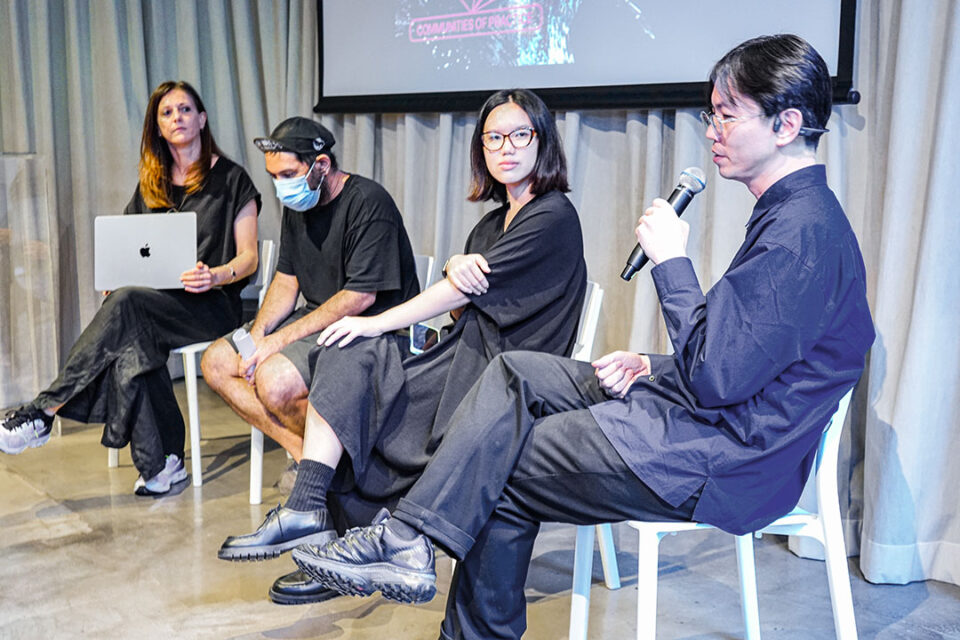
What drives an artist to reconfigure the inner mechanisms of devices we have grown increasingly reliant upon? What acts of mobilisation can an artist perform within existing technological infrastructures to cultivate different types of cultural, social, and emotional agency? Can the artistic imagination interrogate the spiritual dimensions of technology and respond to escalating environmental crises determined by society’s current course of development?
In this joint talk, artists Chok Si Xuan, bani haykal, and Ong Kian Peng reflect upon how these and other similar questions have oriented recent developments in their practices. By addressing structural opacities and power structures, and by fostering an ecological understanding of the relation between humans and technology, their work illuminates some dark corners of fast-paced technological advancement and experiments with alternative forms of being within existing structures. Their research is currently unfolding within the framework of Techno Diversions, the inaugural iteration of NTU CCA Singapore’s research platform Communities of Practice.
Communities of Practice fosters interdisciplinary collaborations and the coming together of communities around shared interests. It situates NTU CCA Singapore as an interdisciplinary body within the research-driven core of Nanyang Technological University, advancing its role as convener, capacity builder, and leading incubator in the arts sector.
Saturday, 9 November 2024, 3.00 – 4.30pm
The Hall, NTU CCA Singapore
Block 6 Lock Road, #01-09
Gillman Barracks, 108934
EMPIRICAL WORKSHOPS
This workshop will introduce participants to natural radio. Natural radio is the emission of Very Low Frequency (VLF) and Extremely Low Frequency (ELF) radio waves due to electromagnetic energy from natural phenomena. These emissions originate terrestrially from lightning and from the Sun’s interactions with the Earth’s magnetosphere, they are among the inaudible voices of the environment. If the low frequencies of these electromagnetic outbursts are transformed into acoustic waves, many of these signals may fall within the range of human hearing. Experiencing electromagnetic waves as acoustic waves will allow listeners to connect with the beauty and complexity of natural radio waves in a unique aural experience.
By the end of the workshop, participants will be able to assemble an analogue handheld radio device that tunes in to natural radio frequencies.
Participants are encouraged to bring their own headphones with a 3.5mm audio jack, along with an optional audio recorder to capture and share their auditory discoveries.
This workshop is part of the Empirical Workshop Series of Communities of Practice. Techno Diversions.
This workshop is suitable for age 18 and above.
No prior knowledge of electronics is required.
Saturday, 21 December 2024, 2 – 5pm
The Hall, NTU CCA Singapore
Block 6 Lock Road, #01-09
Gillman Barracks, Singapore, 108934
METAL MACHINE MISCHIEF (or how to make noise music with bicycles) by bani haykal
“Riding bikes ain’t s#!+ without climate justice, without land back, without liberation of everybody”
Christina Torres, Cyclista Zine
The bicycle is more than just a means of transportation. In our increasingly car-centric and carbon-heavy lifestyle, cycling is a climate action that slows down the rate at which our planet is burning. Inspiring stories from Gaza have shown us how bicycles can be radically repurposed into washing machines, sewing machines, and even power generators.
In the first part of the workshop, participants will be offered a set of unused bicycle components gathered by artist bani haykal and they will be guided to devise and conceptualise new musical or sonic instruments with them. In the second part, these unorthodox instruments will be played in a group jam session!
Participants are encouraged to bring personal items such as mallets, drumsticks, clarinet mouthpieces, and/or any musical bobs and bits they can incorporate into the instruments.
This workshop is part of the Empirical Workshop Series of Communities of Practice. Techno Diversions.
This workshop is suitable for age 18 and above.
No prior knowledge or experience is required.
Saturday, 7 December 2024, 10:30am – 12:30pm
The Hall, NTU CCA Singapore
Block 6 Lock Road, #01-09
Gillman Barracks, Singapore, 108934
Temporal Oscillations. Electronics workshop led by artist Chok Si Xuan
This workshop will explore how to use common electronic components to modulate the flow of electricity, assemble and hijack standard systems of temporality. Participants will learn how a 555 timer integrated circuit (IC) forms an astable multivibrator. The 555 timer IC is a tiny chip found in many everyday devices—blinking LED lights, kitchen timers, alarm systems, sound makers, etc.—that modulates the frequencies of electrical signals. The term ‘astable’ means ‘not stable’ because the circuit never settles into a single state, is a basic electronic circuit that generates a continuous oscillating output, switching between two voltage levels.
Working with pre-assembled circuits created by artist Chok Si Xuan, participants will be able to experiment with various components (small motors, LED lights, and speakers, etc) as outputs. Exploring the transformation of different forms of energy—chemical energy from batteries, mechanical energy , kinetic energy and byproduct thermal energy, the workshop accesses materiality as a manner of understanding the fundamental ways systems unfold.
Through engaging with electronic circuits in a hands-on and accessible way, participants can expect to develop a direct understanding of some visible and less visible aspects that power everyday technology. Participants are encouraged to bring their own components for experimentation. These may include battery-operated toys, LED lights or small light strips, buzzers or small speakers, direct current (DC) motors, small fans, switches or buttons, old electronic parts like sensors or wires, and similar items.
This workshop is part of the Empirical Workshop Series of Communities of Practice. Techno Diversions.
This workshop is suitable for age 18 and above.
No prior knowledge of electronics is required.
Saturday, 7 December 2024, 10:30am – 12:30pm
The Hall, NTU CCA Singapore
Block 6 Lock Road, #01-09
Gillman Barracks, Singapore, 108934

Transdisciplinary Lectures
Presentations by Dr Eugene Chua (Singapore) and Boedi Widjaja (Indonesia/Singapore) followed by a conversation with ong kian peng (Singapore)
What is reality? The models we use to conceptualise the world are increasingly under scrutiny, reshaped by the ecological crises of our time and the revelations of quantum theories. Classical distinctions between humans, non-humans, and objects are dissolving as we zoom in at the quantum level, revealing a world of entanglements and uncertainties. This event brings together artist Boedi Widjaja, whose practice explores the intangible and ephemeral, and philosopher of physics Eugene Chua, whose work delves into the complexities of quantum mechanics. Their presentations will be followed by a dialogue moderated by artist ong kian peng. The panel will unfold some intersections of art, science, and philosophy, offering new perspectives on how we perceive, construct, and engage with reality. Through this exchange, the audience will be offered new lenses for understanding the world and reimagine their place within a dynamic, interconnected cosmos.
Wednesday, 12 February 2025
7 – 8:30pm
The Hall, NTU CCA Singapore
Block 6 Lock Road, #01-09
Gillman Barracks, Singapore, 108934
Lecture by Professor Pooi See Lee (Singapore), followed by a conversation with artist Chok Si Xuan (Singapore)
Will electronics become flexible and soft? As technological advances shrink systems and transition from hard robots to soft machines, how will this affect the way we understand and relate to the devices we interact with?
Professor Lee Pooi See, whose research delves into human-machine interface, hybrid materials for soft robotics, and nanostructures, will share about the influences and current trajectories of material sciences and human-machine interfaces articulating her insights into the future of a softer and smaller world of technology. In conversation with Chok Si Xuan, the scientist and the artist will discuss the implications of a world driven by mechanisms that escape human vision and they will exchange ideas about the relational qualities of interfaces and the rise of biomimicry in the realm of technological innovation.
This event is generated by Chok Si Xuan within Communities of Practice. Techno Diversions, a research programme that aims to propel a transformative understanding of technology through artistic practices and transdisciplinary encounters.
Wednesday, 19 February 2025
7 – 8:30pm
The Hall, NTU CCA Singapore
Block 6 Lock Road, #01-09
Gillman Barracks, Singapore, 108934
Algorithms of Resistance. Tracing tactics of agency and solidarity within platform society
Online lecture by Tiziano Bonini (Italy) and Emiliano Treré (Italy/United Kingdom) followed by a conversation with bani haykal (Singapore)
oday, a growing number of social interactions, economic transactions, political engagements, and affective relations are enabled and regulated by a global network of online platforms operated through algorithms. As algorithmic infrastructures become enmeshed in the fabric of society, more and more aspects of everyday life are being captured and released in data streams that feed digital entities unilaterally coded and controlled by profit-driven tech companies. Through extensive online and offline fieldwork conducted across the Global North and the Global South, Tiziano Bonini and Emiliano Treré—co-authors of Algorithms of Resistance. The Everyday Fight Against Platform Power (The MIT Press, 2024)—ventured into uncharted alghoritmic territories. They encountered forms of agency, practices of resistance, and bonds of solidarity enacted by users who negotiate their own terms of existence within the platform regime. In this lecture, the speakers will reflect on how grassroots practices can spark emancipatory frictions that reinvent and disrupt the uneven power relation between users and platforms.
This event is generated by bani haykal within Communities of Practice. Techno Diversions, a research programme that aims to propel a transformative understanding of technology through artistic practices and transdisciplinary synergies.
Wednesday, 26 February 2025
7 – 8:30pm
The Hall, NTU CCA Singapore
Block 6 Lock Road, #01-09
Gillman Barracks, Singapore, 108934
Yan Jun (China) and Yuen Chee Wai (Singapore)
Time is still and we are in revolution
Live performance streamed through LCD screens, approx. 30 min.
Saturday, 16 September 2023
3:30pm – 4:15pm
NTU CCA Singapore Seminar Room
37 Malan Road, #01-04
Singapore 109452
Performance will start on time.
Admission is free on a first-come first-served basis.
Isn’t there a paradox in any revolution in that they circle back as they move forward? A revolving disc spins the two performers, together with their respective environments and audiences, at the same speed across vast geopolitical distances: an apartment in Bejing (Yan Jun) and former military barracks converted into artist studios in Singapore (Yuen Chee Wai). Set in a mysterious code, Time is still and we are in revolution is an experiment in remote improvisation made of electronics and vocals, cyclical contacts and recurring departures.
Time is still and we are in revolution results from an experimental working methodology developed by Yan Jun and Yuen Chee Wai. The first outcome of this ongoing collaboration, The Riddle of the Machine, was presented at the Trans-Southeast Asia Triennial Research Exhibition Series Review, Guangzhou, China, earlier in 2023.
BIOGRAPHIES
Yuen Chee Wai (Singapore) is a musician, artist, designer, and curator. Often inspired by perspectives glimpsed through the filmic eye and photographic lens, Yuen’s stylistic oeuvre in improvised music is marked by internalised reflections on memory and loss, invisibility and indeterminacy. His latest research interests are in mycology and caves. In 2008, together with Otomo Yoshihide (Japan), Ryu Hankil (South Korea), and Yan Jun (China), he formed FEN (Far East Network), an improvised music unit focusing on the multifaceted networks and collaborations between musicians and artists in Asian countries. He is also a member of The Observatory, in which he plays guitar, synth, and electronics. He tours extensively with FEN and The Observatory, and has presented at MIMI Festival, Lausanne Underground Music and Film Festival, All Ears Festival, Ftarri Festival, Gwangju Biennale and CTM Festival. Yuen was an Artist-in-Residence with NTU CCA Singapore in Cycle 8.
Yan Jun (China) is a musician and poet based in Beijing. His works involve electronics, feedback, site-specific installations, and noise. His improvisation sets follow the unstable relationship between microphones, speakers, the space and his body movement, to create subtle and unstable sound. He is a member of FEN (FarEastNetwork), Tea Rockers Quintet and Impro Committee, and has toured in the US, Australia, Europe and Asia. He has performed at Shanghai Biennale and received an honorary mention by Ars Electronica (Austria), and is the founder of Sub Jam label/organization. As a writer he has published and translated several books and poetry collections and attended the Rotterdam International Poetry Festival, and Berlin International Poetry Festival. Yan Jun was an Artist-in-Residence with NTU CCA Singapore in Cycle 2.
Propelled by an interest in the conceptual frictions between art and craftsmanship, artistic and industrial labour, the artist intends to develop this research into a comparative study of masonry and ceramics, two techniques that have significant affinities in terms of materials but carry different class connotations. Focusing on existing sites such as local brick factories and heritage buildings made of bricks, he will also codify the schemas of bricklaying in an attempt to delineate different morphologies of brick architecture. This research will potentially culminate in a series of material experimentations and pictorial mappings of brick trade, bringing to the forefront the overlooked history of this material in the context of Singapore.
Working at the intersection of painting and sculpture, Ben Loong (b. 1988, Singapore) explores themes and questions of utility within traditional craftsmanship. Through the manipulation of industrial and mass-produced materials and the observation of textures and patterns in the everyday, his practice attempts to challenge the value systems embedded in our material culture. Ben has regularly presented in Singapore, in both solo and group exhibitions. His solo exhibitions include Squaring the Circle, Mizuma Gallery, Singapore (2021); MONO, S.E.A. Focus, Singapore (2020); and Aggregate, I_S_L_A_N_D_S, Singapore (2018). His group exhibitions include Ancient Future Myths, AC43 Gallery, Singapore (2021); FrictionaL and Lingering Manifestations, Pearl Lam Galleries, Singapore and River Stories, LASALLE’s Institute of Contemporary Art Singapore (both 2018); Untapped Emerging, Visual Arts Development Association, Chan + Hori Contemporary, Singapore (2017); Ends, Hart Lane Studios and Joyless Unity, Mori + Stein, both London, United Kingdom (2014 and 2013). He received the Highly Commended mention in the Established Artist Category at the UOB Painting of the Year Competition in 2018.
Informed by art historical and philosophical discourses on the subject/object dichotomy and propelled by a growing interest in stage design, theatricality, and the phenomenology of perception, the artist intends to expand his own image-making process beyond painting, questioning his intuitive relation to the medium at the same time. This experimentation will potentially result into multimedia installations wherein formal and contextual aspects are merged and narratives unfold in space through a combination of visual layers and material components that elicit different modes of spectatorship in the viewer.
This episode features a conversation between two artists who work primarily with painting: our Artist-in-Residence Hilmi Johandi and Singaporean artist and educator Ian Woo. In this peer-to-peer exchange between thoughtful image-makers, Hilmi and Ian ponder over the significance of the studio in Hilmi’s practice revealing how walls, and spaces, can shape artistic mindsets and generate different patterns of thought. Throughout the conversation, they address the potential of a local residency to shift the perception of the familiar, open up new ways of seeing and refresh routines and rituals. They also touch upon the artist-audience relation and other core aspects in Hilmi’s practice such as the role of emptiness in the painted surface, the process of reframing, and the inspiration that comes from old films and photographs.
Drawing on archival footage, old films, and other imagery produced for mass consumption, the artistic practice of Hilmi Johandi refigures the iconography of Singapore and our relation with images. His body of work is deeply rooted in painting but it also harnesses other mediums to mobilise symbols and sites where memory and nostalgia, leisure and desire become deeply entangled.
Ian Woo is an artist influenced by modernist abstractions, the phenomenology of perception, and the sound structures of music improvisation. His paintings, painted objects, and drawings are traversed by a sense of gravitational change that makes the image function as a diagram of states of consciousness. The distinct use of frames, axis, and invisible grids is expressive of his “compartments and systems” approach, a methodology the artist has developed in his exploration of the painted space as activated time.
Contributors: Hilmi Johandi, Ian Woo
Editor: Anna Lovecchio
Programme Manager: Nadia Amalina
Sound Engineer: Ashwin Menon
Intro & Outro Music: Yuen Chee Wai
Cover Image & Design: Arabelle Zhuang, Kristine Tan
As a co-founder of the food study group Bakudapan, Elia Nurvista (b. 1983, Indonesia) employs an interdisciplinary approach towards the discourse around food. Through a wide range of mediums, from video installations to workshops, her works invite reflective participation to think beyond food as an alimentary sustenance. Selected group shows include Dhaka Art Summit 2020, Bangladesh and
Investigating Singapore’s role within the growing global phenomenon of “green cities”, Coburn will pursue research into Singapore’s development from “Garden City” to “City in a Garden”. He aims to delve into historical and emerging notions of green urbanism, framing the garden as a pedagogical, philosophical, and literary construct. Focusing on two specific case studies, he will place the multiple functions of Singapore Botanic Gardens in a wider historical prospective and explore the social and economic conditions which underlie the complex eco-tourist structure of Gardens by the Bay.
Furthering his own interests into the histories and properties of materials, during the residency Richard Streitmatter-Tran plans to engage with an active studio practice and to experiment with both animate and inanimate materials from Southeast Asia to develop new skills and focus on the next steps of his production.
Since 2014, Min Thein Sung has been collecting historical, sociological, and material data for the project Mr Tailor had a dream last night: a soft-sculpture installation made of raw linen fabrics that recreates a small tailor shop, a space for craftsmanship that is still common in Myanmar but fast-dwindling in Singapore. Addressing the alienation of the consumer from the garment-maker and the resilience of this kind of handicraft in the face of today’s industrial mass production, the artist intends to engage with local taylors and with the tools of the trade in order to create a new sculptural piece.
The rich visual language of Dana Awartani’s (b. 1987, Saudi Arabia) paintings, sculptures, and textile installations incorporate traditional Islamic art forms into contemporary aesthetics. Engaging with the relationship between geometry and nature, she harnesses the timeless and enduring relevance of forms in order to deconstruct contemporary issues such as gender, faith, loss, and cultural destruction. Past solo exhibitions include The Silence Between Us, Maraya Art Centre, Sharjah, United Arab Emirates (2018) and Detroit Affinities: Dana Awartani, Museum of Contemporary Art Detroit, United States (2017). She has participated in numerous group shows and biennales such as Kochi-Muziris Biennale 2016, Kochi, India and the 1st Yinchuan Biennale, Museum of Contemporary Art, Yinchuan, China (both 2016), among others.
The artist was scheduled to be in-residence from July – Sept 2020. Due to the COVID-19 virus outbreak and international travel restrictions, the artist was unable to participate in the residency programme physically.
Vivian Wang diverged from her formal training as a classical pianist when she started the avant-rock outfit The Observatory in 2001. A former TV producer-presenter as well as a film music supervisor, Wang focuses solely on music, performance, and interdisciplinary work since 2008. She performs on synth, keyboard, voice, and percussion, and tags Alice Coltrane, Robert Wyatt, Mark Hollis, Bill Evans, and Annapurna Devi as her all-time favourite musical heroes.
“Patterns – cloth and textiles as text in Southeast Asia – imbedding cultural interrelations and the question of identities” in times of global sameness, is Regina (Maria) Möller‘s research focus. Möller’s research in The Lab stems from her interest in the trademark headdress of Samsui women, and will elaborate with time through experimental, collaborative and participatory forms of research practice. During workshops, lectures or formats of story telling, new layers will be added to reflect upon each other and trigger next threads for an ever expanding weave.
Amy Lien (b. 1987, United States) and Enzo Camacho (b. 1985, Philippines) perhaps recklessly assume the near total dissolution of creative agency as participants in the financially networked public sphere commonly referred to as “art world”. Yet, this does not prevent them from generating ever more questions via an image-oriented material production, continuously inaugurating a kind of affective and data-frantic cartography of places connected and disconnected to each other, while employing the standard theoretical rubrics of economics‚ and contemporary art. What results is something like mixed media sculpture, or installation art.
The two artists began collaborating in 2009, between New York and Manila. They both received their Bachelor’s degrees from Harvard University (Lien in 2009; Camacho in 2007), and their Master’s degrees from the Hochschule für bildende Künste Hamburg (both in 2014). Most recently, they were Artists-in-Residence at Gluck50 in Milan, where they curated a group exhibition including artists based in New York, Taipei, and Cairo. They have had solo exhibitions at 47 Canal (New York, USA), Mathew Gallery (Berlin, Germany), Republikha Art Gallery (Quezon City, Philippines), and Green Papaya Art Projects (Quezon City, Philippines), as well as participated in recent group exhibitions at the Kunstverein in Dusseldorf and the Künstlerhaus in Bremen.
The mixed-media selection presented in The Vitrine stems from Railtrack Songmaps, a project exploring competing claims to nature and culture that resound along the former Malaysian railway tracks at Tanglin Halt. For at least five decades, birds, nature lovers, songbird clubs, tree shrines, kampung gardeners and foragers have roosted and seeded themselves along the tracks, nurturing a tangled patch of urban wild that is currently undergoing redevelopment. The particular constellation of elements on display – photographs, Malay pantuns, embroidery on paper, and delicate airborne assemblages of images, cut-outs and coconut sticks – weave in and out of memories of Lim Kim Seng, who together with his brother Lim Kim Chua, joined the Nature Society of Singapore (NSS) as teenager. Both are now senior members of the NSS Bird Group. Kim Seng assisted The Migrant Ecologies Project in the identification of 105 bird species around Tanglin Halt. In an accompanying soundtrack he recalls how an early encounter with a kingfisher first drew him into a bird zone.
The Migrant Ecologies Project was founded in 2010 by artist, art writer, and educator Lucy Davis. Investigating movements and migrations of nature and culture in Southeast Asia and beyond, the project unfolds through collaborations with sound artists, photographers, scientists, and designers.
Lucy Davis has been an Artist-in-Residence at NTU CCA Singapore from April to June 2017.
Tarek Atoui studied contemporary and electronic music at the French National Conservatory of Reims. He navigates between the vocabularies and aesthetics of the visual arts, performing arts, and music, redefining contemporary composition and sound production. In 2012, Atoui launched Serpentine Gallery’s Memory Marathon event in London with a five-hour performance that blended influences of traditional Arabic music with contemporary genres including electronic and hip-hop. He was co-artistic director of the Bergen Assembly 2016, a triennial in Norway. Recent projects have taken place at the Tate Modern, London (2016); Fondation Louis Vuitton, Bois de Boulogne (2015); Bonniers Konsthall, Stockholm (2013); and Norbergfestival (2013). Selected exhibitions include Art or Sound, Fondazione Prada, Ca’ Corner della Regina, Venice (2014); Within, Sharjah Biennial 11 (2013); Metastable Circuit, la Lutherie and Dimis Reconnected, dOCUMENTA 13, Kassel (2012). His work has been part of biennials including the Marrakech Biennale (2016); 8th Berlin Biennial (2014); 9th Biennale do Mercosul, Porto Alegre (2013); and the 9th and 11th Sharjah Biennial (2009/13).
Sopheap Pich left Cambodia with his family as a refugee at the end of the Khmer Rouge’s reign, settling in the United States in 1984. Memories of his childhood and a desire to reconnect with his home country drew the artist back to Cambodia in 2002. He began working with local materials—bamboo, rattan, burlap from rice bags, beeswax, and earth pigments gathered from around Cambodia—to make sculptures inspired by bodily organs, vegetal forms, and abstract geometric structures. The strength, durability, lightness, and incredible malleability of rattan allow Pich to create organic forms that have become a signature of his practice. Pich holds a BFA from the University of Massachusetts at Amherst (1995), and an MFA from the School of the Art Institute of Chicago (1999). In 2013, Pich presented a solo exhibition at the Metropolitan Museum of Art, New York, entitled Cambodian Rattan: The Sculptures of Sopheap Pich. Selected group exhibitions include the 57th Venice Biennale (2017); the Moscow Biennale (2013); Documenta 13, Kassel (2012); the Singapore Biennial (2011), among others. His work was presented at NTU CCA Singapore as part of Guggenheim UBS MAP Global Art Initiative’s No Country: Contemporary Art for South and Southeast Asia (2014), curated by Dr June Yap.
NTU Centre for Contemporary Art Singapore (NTU CCA Singapore) is pleased to present the first solo exhibition in Southeast Asia by sound artist and composer Tarek Atoui, conceived as a composition that unfolds in space with its unique sound library and instruments. It is the first large-scale exhibition that Atoui has created through interweaving objects, instruments, and recordings, some borrowed from pre-existing projects, others newly collected and produced.
The Ground: From the Land to the Sea comprises two layers of auditory experiences that interact with each other as well as with the spatial and sonic qualities of NTU CCA Singapore’s exhibition hall, merging them into a single composition. Enveloping the main exhibition space are a set of speakers that play the sounds of underwater environments as well as human and industrial activities in the harbours of Athens and Abu Dhabi, recorded for the project I/E (2015–ongoing). Building upon the sound collection, Atoui has, as part of this presentation in Singapore, recorded at local harbours and waterfronts, together with composer and sound artist Éric La Casa.
The recording process in Singapore took Atoui and La Casa to a range of waterfront sites and islands including the Jurong Fishery Port, Pulau Sebarok (an oil storage facility and refuelling port off the Southern coastline), on an oil tanker, and along the Singapore shores. During these trips, the duo picked out acoustic features of these environs, both underwater and on land, and captured them in their diverse forms—as vibrations, audible noise, and inaudible audio waves, etc.— using devices such as a recorder, a hydrophone, contact microphones, and selfmade omnidirectional microphones. Drawing reference to the emergence of acoustic ecology, which attempts to understand and analyse characteristics of sonic environments such as geological formations, organisms, and human interactions, Atoui’s auditory library is an artistic interpretation of the ecology of our times. Set within a “white cube,” the audience is transposed into an immersive audio-visual topography, becoming part of the installation.
Most of the instruments shown are part of The Ground project, the result of the artist’s five-year-long investigation of natural cycles in the Pearl River Delta, first presented at Mirrored Gardens, a project space in Guangzhou, China, in 2017. Also presented are instruments created for previous projects, such as The Reverse Collection (2014–16) and WITHIN (2012–13). This ensemble of unusual instruments is enriched with new additions, including a set of porcelain and ceramic discs, on which traditional Arabic rhythms are engraved, and a customised record player that rotates at irregular speeds, never reading a disc the same way twice.
At the core of Atoui’s practice lies an ongoing process of inviting composers, musicians, and artists to collaborate on his pieces in search of new ideas, gestures, and experiences. For the current exhibition, Atoui will engage with local and international musicians who will be invited to appropriate his composition and intervene in the exhibition space. He will work with acclaimed sound artists and musicians Vivian Wang and Yuen Chee Wai, as well as music curator Mark Wong, who in turn will invite other musicians and sound artists to inhabit the installation throughout the course of the exhibition.
The exhibition is curated by Ute Meta Bauer, Founding Director, NTU CCA Singapore, and Professor, School of Art, Design and Media, Nanyang Technological University, and Khim Ong, Deputy Director, Curatorial Programmes, NTU CCA Singapore. Supported by Institut français, with the additional support of the Embassy of France in Singapore and Institut français Singapour.
Tarek Atoui has invited local and international musicians to engage with his exhibition and appropriate the installation for given periods of time. He worked with acclaimed sound artists and musicians Vivian Wang and Yuen Chee Wai, as well as music curator Mark Wong, who each will host three other musicians and sound artists. The guests will inhabit the exhibition and freely experiment with Atoui’s instruments throughout the course of the exhibition. Schedule for upcoming Guest Musicians in the Exhibition Hall: Vivian Wang (Singapore): 26 – 30 March Yuen Chee Wai (Singapore): 31 March – 3 April Darren Ng (Singapore): 7 – 10 April Uriel Barthélémi (France): 13 – 17 April Tini Aliman (Singapore): 28 April – 1 May Wu Junhan (Singapore): 2 – 5 May The Analog Girl (Singapore): 10 – 13 May Cheryl Ong (Singapore): 19 – 22 May Zai Tang (Singapore): 31 May – 3 June Bani Haykal (Singapore): 4 – 7 June Dharma (Singapore): 13 – 16 June Sudarshan Chandra Kumar (Malaysia): 19 – 22 June
NTU Centre for Contemporary Art Singapore is embarking on an inquiry into natural materials, exploring the knowledge they embody as biological forms as well as within social, geopolitical, and historical contexts.Trees of Life – Knowledge in Material is part of the Centre’s long-term research cluster Climates.Habitats.Environments.
This exhibition focuses on materials from four plants deeply rooted in Asia: indigo (Indigofera tinctoria), lacquer (Rhus succedanea and Melanorrhoea usitata), rattan (Calamoideae), and mulberry (Morus). The works trace the ongoing involvement with these plants in the artistic practices of Manish Nai (India) with indigo, Phi Phi Oanh (United States/Vietnam) with lacquer, Sopheap Pich (Cambodia) with rattan, and Liang Shaoji (China) and Vivian Xu (China) with mulberry silk. While the featured installations serve as a starting point to uncover the materiality of the chosen plants, the study of their natural and cultural DNA allows further exploration into their biological processes and diverse usages at their locale.
The artworks intertwine with selected research documents that address the complex histories and circulation, as well as the effects of human intervention on these natural resources. Starting from the properties and characteristics of the materials themselves, the project expands into their cultural representation and significance for communities and their crafts.
The longstanding social and cultural practices associated with indigo, lacquer, rattan, and mulberry silk have accumulated a vast repository of knowledge, whether formal or tacit. Beyond the format of the exhibition, topical seminars will be dedicated to each of the four materials, further investigating their social applications over centuries in terms of their materiality, cultural references, or expanded ecology, and as arising from technological advancements. The lectures, panels, talks, and workshops feature the participating artists, as well as craftsmen, scientists, ethnobotanists, anthropologists, scholars, and designers who are working with these materials and researching innovative applications. From the diverse perspectives offered by the contributors, the public programme excavates layers of meanings and reiterates the deeper role art and craft traditions have in supporting local communities and their ecosystems.
Topical seminars take place between 21 July and 8 September 2018.
On Lacquer: 21, 22 July
On Rattan: 25, 26 August
On Indigo: 4, 19 August, and 1 September
On Mulberry: 8 September
The project Trees of Life – Knowledge in Material is led by Ute Meta Bauer, Founding Director, NTU CCA Singapore and Professor, NTU School of Art, Design and Media (ADM); Laura Miotto, Associate Professor and Co-director, MA Museum Studies and Curatorial Practices, NTU ADM; and Khim Ong, Deputy Director, Curatorial Programmes, NTU CCA Singapore.
Simryn Gill’s first major solo exhibition in Southeast Asia brings together a series of works that reveal the artist’s specific attitude towards how we produce meaning and make a place for ourselves in the world. NTU CCA Singapore will present three photographic series: Standing Still (2000- 03), Dalam (2001), May 2006 (2006), and a new work, Like Leaves (Syzygium grandis) (2015). Much of Simryn Gill’s work results from a process of sifting through and documenting her immediate surroundings creating quiet and at the same time commanding work marked by history, culture, the passage of time, and the poetry of daily life.
Curated by Ute Meta Bauer, Founding Director and Anca Rujoiu, Curator, Exhibitions.
Éric La Casa has worked in the field of sound creation since the early 1990s through recording, record production, installation, radio, and various types of written publications. Through his aesthetic of capturing sound, his work fits equally into the fields of sound art and music, offering an interesting critical approach to the practice of sound landscape, and questioning our listening methods and schemes. He has recently examined the sound dimension of public spaces and the places in which we spend our private and domestic lives in the context of the project entitled Habiter, and the relation between waiting and listening in L’attente. La Casa collaborated with Tarek Atoui on recording the harbour of Abu Dhabi in 2017 and of Singapore in 2018 for the I/E project.
Drawing inspiration from music, design, literature as well as his own life experiences, the multidisciplinary practice of Kartik Sood(b. 1986, India) revolves around the delicate balance of coexistence, investigating the tension that arises between the handmade and the mechanical, materials and concepts. Sood’s artworks examines these tensions through the manipulation of a variety of mediums such as gouache paintings, moving images, and installations with archival photos and found objects that unfold ambiguous narratives.
Kartik Sood lives and works between Baroda and Delhi, India. His works have been widely exhibited in India and, most recently, he participated in the Yinchuan Biennale, China (2016). In 2014, he undertook a residency at Gasworks, London, United Kingdom.
Liang Shaoji’s practice intersects science and nature, biology and bio-ecology, weaving and sculpture, and installation and performance. He has been working with silkworms for almost three decades, using the life process of these insects as a medium. Liang graduated from the Zhejiang Academy of Fine Arts (now renamed China Academy of Fine Arts, Hangzhou) in 1965 and studied at the university’s Varbanov Institute of Tapestry. Now working in Tiantai, Zhejiang Province, his works are filled with a sense of meditation, philosophy, and poetry, while illustrating the inherent beauty of silk. Selected exhibitions include Cloud Above Cloud, Museum of China Academy of Art, Hangzhou (2016); What About the Art?, Contemporary Art from China, Al Riwaq, Doha (2016); Liang Shaoji: Back to Origin, ShanghART Gallery, Shanghai (2014); Art of Change, Hayward Gallery, London (2012); Liang Shaoji, Prince Claus Fund, Amsterdam (2009); among others. He was awarded the Prince Claus Award in 2009 and the Chinese Contemporary Art Award (CCAA) in 2002. In September 2018, Liang will have a solo exhibition at M Woods, Beijing.
Manish Nai concentrates on the material qualities of the various substances he utilises in his work. His interest is in the discovery of abstract forms through the physical manipulation of matter, and the new life assumed by cast-offs when transformed from objects of use to objects of art. Using the colour indigo (indigo dye), itself loaded with a multitude of representations and associations, this opens up the visual form to subjectivities in the interpretation of the medium throughout time. Nai’s work was included in A beast, a god, and a line, curated by Cosmin Costinas, which debuted during the Dhaka Art Summit 2018 and subsequently travelled to Para Site, Hong Kong (2018). In 2017, the Fondation Fernet Branca in St. Louis, France, presented a comprehensive exhibition of the artist’s paintings, murals, sculptures, and photographs. The exhibition will travel to the Het Noordbrabants Museum in The Netherlands. Other group exhibitions include Asymmetrical Objects, Dr Bhau Daji Lad Museum, Mumbai (2018); the Kochi-Muziris Biennale (2014); and the Shanghai Biennale (2012). He has newly completed an 18-metre-long sculpture as a permanent installation in Mumbai’s Bandra-Kurla Complex. His works are on view at the Sculpture Park at Madhavendra Palace, Rajasthan, India (2017–18), and at the Smart Museum of Art in Chicago as part of its permanent collection.
Mark Wong has been active in experimental music, sonic arts and independent music practice in the last decade, playing multiple roles as organiser, programmer, artist, curator, writer, and label producer. His sound compositions, site-specific works, sound walks, sound objects, and multi-channel installations have been exhibited at Singapore Art Museum, 8Q@SAM, Institute of Contemporary Arts Singapore, Jendela (Visual Arts Space), and Yavuz Gallery. In 2010, Wong conceived Ujikaji as a music label and event organiser with a focus on experimental music in Singapore and Southeast Asia.
Phi Phi Oanh’s work is informed by her inquiry into lacquer as a material combined with her studies of the Vietnamese lacquer painting (sơn mài) tradition. Drawing from the hybrid nature of her personal history, Oanh constructs pictorial and evocative installations that reconfigure culturally-specific signs and symbols, creating familiar yet distinctive experiential spaces. In 2004 she was awarded a Fulbright Scholarship to study traditional Tranh Sơn Mài (Vietnamese lacquer painting) in Hanoi, which has since become a key medium in her practice. She has had solo exhibitions at L’Espace, Alliance Française in Hanoi; Artcore in Los Angeles; Art League in Houston; as well as El Palacio Nacional de la Cultura in Managua. In 2016, she was commissioned to create Pro Se, a work for the National Gallery Singapore and also showed her monumental Specula in the Singapore Biennale (2013).
Richard Serra is one of the most preeminent and visionary artists of his generation. In the 1960s, he and other Minimalist artists employed non-traditional, industrial materials to emphasise the materiality of their work. He subsequently expanded his spatial and temporal approach to sculptures to large-scale, site-specific work, of which his arcs, spirals, and ellipses are most renowned. These monumental works engage their viewers as they are experienced in situ. In 1968, he produced his first short film and experimented with video in the 1970s. Serra has held numerous museum shows and participated in important international exhibitions around the world.
Richard Streitmatter-Tran (b. 1972, Vietnam) lives and works in Ho Chi Minh City. Since 2013, his practice has shifted from performance and new media to sculpture, painting, and drawings. This “return to craft” is fueled by a preoccupation with material knowledge over concept and is framed by a deep-rooted interest into modes of learning that used to be passed down through generations and are now being erased by the diffusion of new technologies.
His solo and collaborative works have been exhibited internationally including Hong Kong Arts Centre (2017), Palais de Tokyo, Paris, France (2015), Singapore Art Museum (2016, 2012, 2009), Asia Triennial, Manchester, United Kingdom (2011), Singapore Biennale (2008, 2006), among many others. Streitmatter-Tran has also been involved in numerous writing, education, and curatorial projects. In 2010, he established DIA/PROJECTS, an experimental art space in Ho Chi Minh City. He also co-curated with Russell Storer the exhibition The Mekong at The Queensland Art Gallery, Brisbane, Australia (2009) that was part of the 6th Asia Pacific Triennial.
The cross-media practice of Rossella Biscotti (b. 1978, Italy/Belgium/Netherlands) cuts across sculpture, performance,sound works, and filmmaking. Stemming from extended research processes, conceptual excavations,personal encounters, interdisciplinary collaborations, and the subtle interrogation of sites and stories,her works encapsulate meticulous stratifications of materials and meanings. She has taken part in majorinternational exhibitions such as Dhaka Art Summit, Bangladesh (2020); 55th Venice Biennale, Italy (2013); 13th Istanbul Biennale, Turkey(2013); dOCUMENTA 13, Kassel, Germany (2012), and Manifesta 9, Belgium (2012). Recent soloexhibitions were held at Witte de With, Rotterdam, Netherlands (2019); Kunsthaus Baselland, Muttenz,Switzerland (2018), and V‚A‚C Foundation, Moscow, Russia (2016). Biscotti received several awards including ACACIA Prize for Contemporary Art (2017) and Mies van der Rohe Stipendium (2013).
Vivian Xu’s practice focuses on the exploration and intersection of electronic and bio media. While creating new forms of machine logic, life, and sensory systems, Xu explores the possibilities of designing a series of hybrid bio-machines that are capable of generating self-organised silk structures that combine the silkworms’ natural production process with automated computational systems of production. She is the co-founder of Dogma Labs, a cross-disciplinary laboratory based in Shanghai, dedicated to integrating design, research, education, and production with the areas of computation, biology, and digital fabrication. Xu holds an MFA in Design and Technology from Parsons the New School for Design, New York (2013) and is currently a Global Pre-Doctoral Fellow at New York University Shanghai. Xu has exhibited and lectured at various institutions around the world, including the National Art Museum of China, Beijing; Central Academy of China, Beijing; Chronus Art Center, Shanghai; Rockbund Art Museum, Shanghai; Art Laboratory Berlin; SymbioticA, the University of Western Australia; and China Academy of Art, Hangzhou.
Zarina Muhammad (b. 1982, Singapore) is an artist, educator, and researcher whose practice critically re-examines oral histories, ethnographic literature, and historiographic narratives of Southeast Asia. Working at the intersections of performance, text, installation, ritual, sound, moving image, and participatory practice, her work explores the enmeshed contexts of ecocultural cosmologies, identities and interactions, mythmaking, haunted historiographies, and geo-spirited landscapes. Her long-term interdisciplinary project investigates Southeast Asia’s evolving relationship with spectrality, ritual magic, polysensoriality, and the immaterial, examining these themes against the backdrop of global modernity, the social production of rationality, and transcultural exchanges of knowledge. Her work has been widely presented at international biennales and institutions, including FotoFest Biennial, Houston, USA (2024), the 2nd Diriyah Contemporary Art Biennale, Saudi Arabia (2024), the 7th Singapore Biennale (2022), and the 3rd Lahore Biennale, Pakistan (2024). She recently had a solo presentation, curated by Shubigi Rao, at the Singapore Pavilion at the 15th Gwangju Biennale, South Korea (2024). Zarina is the recipient of the 2022 IMPART Art Prize.
By disclosing rarely-seen preparatory drawings, sketches, and embroidery tests from the artist’s archive, Loose Leaves offers an intimate foray into the process of making Listen to my words (2018). An immersive installation by Dana Awartani, Listen to my words combines hand-embroidered silk panels and recordings of Arabic poems recited by modern-day Saudi women to confront issues of silencing, invisibility, and gendered divisions of space deeply entrenched in the cultural fabric of the Middle East.
Drawn from the significant but scarcely documented tradition of female poets in the Arab world from the pre-Islamic era to the 12th century, the poems selected by the artist express feelings of love, yearning, and pride. They relay modes of awareness, stances of resistance, and acts of empowerment often centred on the female body.
The distinct visual language articulated by the geometric patterns—bearers of sacred values in Islamic culture—references the ornamental motifs found on jali (or mashrabiya), lattice screens used in traditional Islamic architecture to control the circulation of air and light as well as to shield women from the male gaze.
Presented alongside the original audio recording, Loose Leaves layers a selection of preparatory studies in the enclosed space of The Vitrine to provide a glimpse of the subtle negotiations that inform Awartani’s creative journey across different techniques and materials.